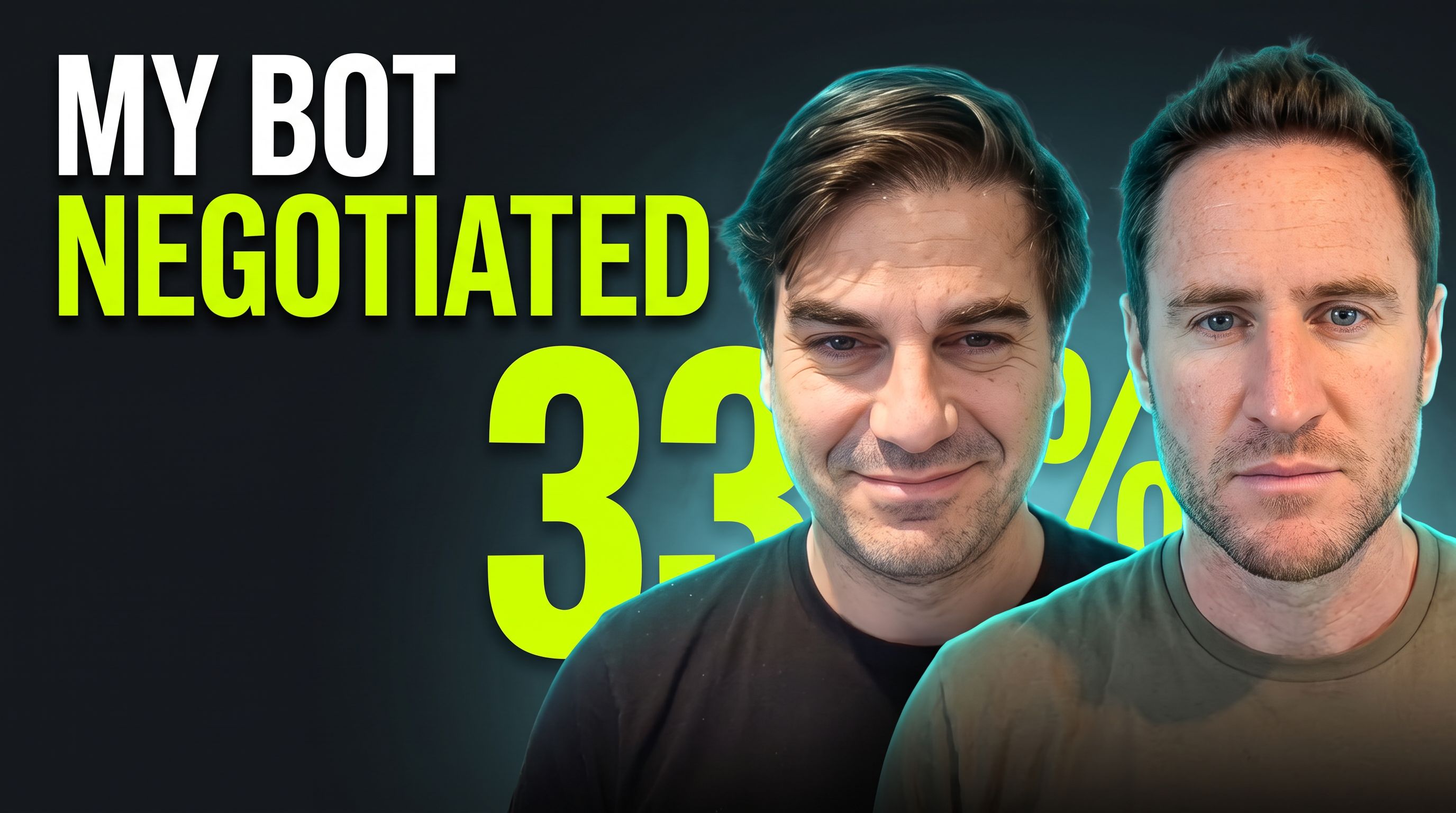
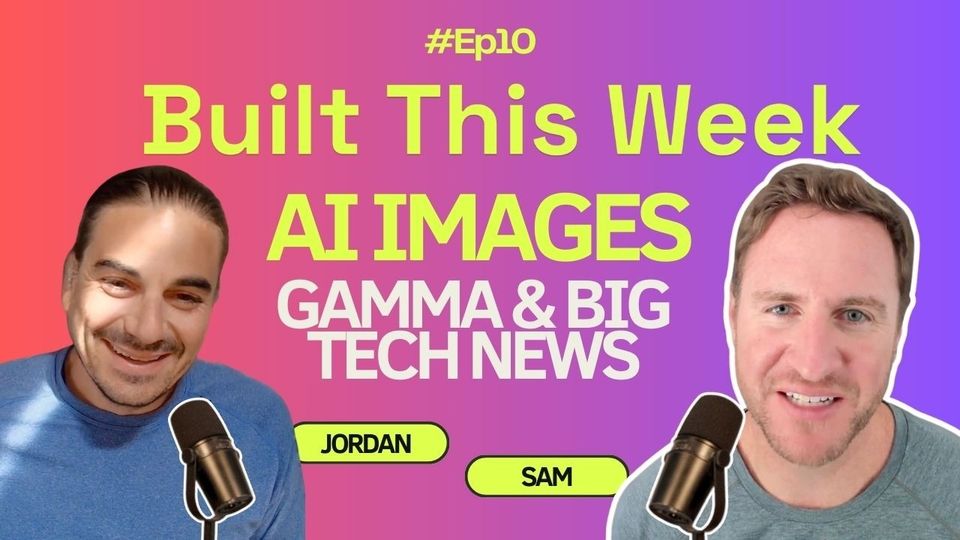
0:00Jordan Metzner shows a chatbot image editor he built putting him in a brown cowboy hat on a ranch from a quick screenshot. Sam Nadler says the episode also covers AI news and a tool for fast deck creation.
1:38Jordan Metzner says AI has not replaced Photoshop partly because continuity is hard: asking for a cowboy hat on Sam should still give you Sam, not a lookalike. New models such as Google's Nano Banana make this easier.
3:58Jordan Metzner uses the Kontext Pro edit tool in his app to add a brown cowboy hat, a western shirt with hot pink accents and a bolo tie, each edit building on the last image; he expects some continuity degradation over time.
6:15Jordan Metzner tries adding a green glass beer bottle as a product placement example and warns that in the wrong hands it could be dangerous, such as showing someone drinking who does not drink.
8:41Jordan Metzner says Google's Gemini image upgrade can merge two images, such as a person and a dog on a basketball court, or add a couch for interior design, and expects developers to build it into ecommerce apps.
10:50Jordan Metzner says Anthropic is entering the browser agent space after Perplexity's Comet and OpenAI's agent, and imagines Claude opening ten to fifteen tabs on Google Flights or Expedia to find the best flight deal.
13:24Jordan Metzner says viewers believe the video used an AI crowd with deformed faces, calling it the beginning of artists using AI as trickery. Sam Nadler expects public figures to use AI to influence audiences to some degree.
15:02Sam Nadler says Gamma uses AI to speed up presentation and website building: a short prompt produces an editable card outline, then you choose a theme, an AI image model and a style such as line art.
17:56Sam Nadler says he mostly uses Gamma for professional one pagers without a designer, getting 65 to 80% of the way there. Jordan Metzner says it can export to PDF, PowerPoint or Google Slides.
21:07Jordan Metzner says the time consultants spend making decks will go to zero, and a litigation attorney told him his firm is hiring fewer data researchers because ChatGPT and other AI tools handle case research.
AI Image Editing That Keeps Your Face: Our Chatbot Build: the key questions from this episode, answered with quotes and timestamps.
Jordan Metzner [0:00]: I took this quick screenshot, of myself, and I think it might be good if you give me a few suggestions. So maybe you can give me, like, a style, some ideas so we can change this up just to show this is, kinda hot off the fly.
Sam Nadler [0:11]: I would love to see you with a, brown colored cowboy hat.
Jordan Metzner [0:16]: Here, you can see the outcome. Here I am in a brown hat, and I'm on a ranch. Built this week, breaking it down. Built this week, we show you how. A fresh idea, a clever tweak you locked in
Sam Nadler [0:34]: Hey, everyone, and welcome to Built This Week, the podcast where we share what we're building, how we're building it, and what it means for the world of AI and startups. I'm Sam Nadler, cofounder at Ryz Labs, and I'm joined each and every week by my friend, business partner, and cohost, Jordan. Hey, Jordan. How's it going?
Jordan Metzner [0:52]: Hey, Sam. Super excited. Another huge week, summertime in episode 10. Lots going on. So so much progress. So excited to talk about it.
Sam Nadler [1:01]: Great. So the docket for this week, we're gonna cover a tool we built in the last week, somewhat similar to our video generation tool, but using the latest image generation tools. As always, a little bit of AI news. Then we'll cover a new AI tool. I'm by no means a power user, but I've used it recently for some you know, really great for deck creation or one pager creation, that makes it super simple, and the design very, very quick and easy.
Jordan Metzner [1:35]: I guess we shall jump right into it. How about we?
Sam Nadler [1:38]: Jump right into the tool of the week. I think before you demonstrate the tool, I would love, like, a little bit of context. This is, like, right off the press. I mean, I think the tool that is the kind of foundation for this internal tool we built was launched yesterday. Give us a little bit of context of what's going on in the market and then the idea behind this tool?
Jordan Metzner [1:56]: Yeah. I think, I mean, everybody's going for, to try to replace Photoshop with AI. Photoshop is a huge tool, super robust. It has, tons of technology that's been built over twenty to thirty plus years of software development. Even though Figma is incredibly successful, great IPO, it hasn't replaced tools like Photoshop and some of the other Adobe Suite tools that are currently used by professionals every single day. Part of that is that, essentially creating continuity with AI is incredibly difficult. And what do I mean by continuity? Continuity, mean by, using a an image, asking AI to make changes to that image, and having the final image have those changes, but keep the continuity of the characters of the person throughout those changes. So if I ask something like, put a cowboy hat on Sam, I get a cowboy hat on Sam, but I still get Sam. I don't get another face that looks kinda like Sam.
Jordan Metzner [2:49]: And continuity has been somewhat challenging for most of these AI models. And with the release of a few new most recent models, including Google's new Nano Banana model, which we'll talk about a little bit later in the episode, it has made it easier to, essentially use AI to describe what you'd like to do and how you'd like to get it built. I have built us a small kind of chatbot based image based editing tool, And I'll show you a small sample of it here, and we can kind of play with it just to show how a fun tool like this could be valuable to, kind of any small business, especially like kind of ecommerce businesses or other businesses in which, they constantly need to make product shots, headshots, all different types of things. So I took this quick screenshot of myself right before we start to record this episode. And I think it might be good if you give me a few suggestions. So maybe you can give me, like, a style and maybe some ideas so we can change this up just to show this is, like, kinda hot off the fly.
Sam Nadler [3:57]: Yeah. Well, I've been thinking about creating, from Nashville, Tennessee, a cowboy hat brand. I would love to see, you with a, brown colored cowboy hat and a white cowboy hat on a ranch.
Jordan Metzner [4:19]: Alright. So I wrote that out there. Add a cowboy hat that is brown and update the clothes as well on a ranch in Tennessee. And as you can see right now, I'm in an office type virtual background environment. And right now, I'm using the Kontext Pro Edit tool, and here you can see the outcome. Here I am in a brown hat and I'm on a ranch. My shirt kinda looks the same, but maybe that's like ranch appropriate. And there I am. If you want, we can probably make some more changes to it if you'd like.
Sam Nadler [4:52]: Yeah. I would immediately, what I find interesting is the lighting. So on your first picture, you have this shadow across your chest. And on the second, it does you know, I wouldn't say it looks still a little AI generated, but, the lighting changes. It looks fairly natural, the lighting, on how the hat would create that shadow across your, I guess, left shoulder. But why don't we change your shirt to be more of a, like, a western button down?
Jordan Metzner [5:22]: Let's try that. So it should, if it works right with my tool, should take this new image as the root, make the changes here, process them, and
Sam Nadler [5:33]: There we go.
Jordan Metzner [5:34]: There we go. Now, you have to understand these are this is like an image of an image. So, it continues to make changes, and we'll probably see, like, some kind of continuity degradation over time. But, you know, let's see. Make the western shirt have hot pink colored accents.
Sam Nadler [6:00]: And a bolo tie.
Jordan Metzner [6:01]: And that should do it. Let's see. Hopefully, it still looks like me once it's all said and done. And there we go. Look at our progress here as we've gone from kinda like cowboy hat to western shirt, etcetera. Right? And, make me look like a animated character. And there I am as a cartoon character with a cowboy western hat, and maybe you take that and you do something with it. But, I think if we just kinda go back one more time, just to kinda use one more like business example. Can you have me holding a bottle of beer and with green glass? So like if you wanted to do kind of product placement as an example, let's see if this works because it may have some safety precautions here, but I think you got it right there. And you know, you could essentially, add in your product and you could add in your Photoshop and your branding and there you go. Right? Have me drinking the beer. Let's see if this one's a little more challenging, but hopefully, I could pull it off.
Jordan Metzner [7:17]: Not exactly.
Sam Nadler [7:19]: Eat somewhere. Well, just for additional context, I mean, you built this from yesterday to today.
Jordan Metzner [7:25]: Yeah. Yeah. And, like Yeah.
Sam Nadler [7:27]: Pretty good. So, I think one is we like to, like, move fast, try and provide access to our teams very quickly on tools that may be of use for them. But that doesn't mean everything is immediately perfect.
Jordan Metzner [7:43]: No. Definitely not. I mean, obviously, this is just like a little prototype. I think it's just showing some of the extent and some of the fun you can have with some of these models. With OpenAI, they've had a image generation for a while, but not continuity. So, I mean, here's me drinking a beer, you know. And obviously, this could be dangerous too. I think that's like something else to think about. Right? Like, in the wrong hands, this definitely could be used dangerously. What if I don't drink alcohol and, etcetera. So, obviously, it's just the beginning of how AI will be used to manipulate images. The real question is is like, is this real or is this not real? Right? I mean, it has my name on it, like, was this I was in a Zoom meeting drinking a beer. What? Like, so, maybe this looks artificial today, but, it may not look artificial tomorrow with just, one or two more improvements. So and obviously, this could be done for, like I said, any type of product placement, actors, models, and a bunch of other types of context, of course.
Sam Nadler [8:41]: So I know it was a bit of a flop for us, and I know it launched yesterday. Just now in this demo is a little bit of a flop, but what is the hype specifically? I mean, these tool there's been versions of these tools. Like, why is Nano Banana theoretically better? Like, what is the hype about? Is it all about the continuity?
Jordan Metzner [8:59]: Yeah. I mean, I think they call it, like, an upgrade, and we can jump into it. Like, Google Gemini's upgrade gets the bananas upgrade. And so what they say they're able to do is kind of, like, merge two images. So here's an example of, like, a person plus a dog, and they want them on a basketball court, and now they're together on a basketball court. I do have Gemini, and I could definitely try this in Gemini. We could like kind of see how well that works. And so maybe that model is being different than the one I'm I'm running through on my application layer. But here it shows you kind of like, using it for, photo design. Right? As I mean, for interior design as you're able to like add a couch or, add a wall to a room or if it's something like that. So I think, we're gonna just begin to see the power of this because, this is at the level in which developers will be able to apply this to applications, and I think you'll be able to see this, natively, probably on your iPhones and, Android phones, but also probably within a bunch of different types of applications as well that will help you ideate things for purchase and ecommerce and a bunch of other stuff, and then, hopefully help you buy them. I think, as we go through it, let's just jump through the news, and then we can kind of jump through the tool of the week after that. So, obviously, Google's dropping new models. What we haven't seen is a new model that's been better than the Veo 3 model from Google.
Jordan Metzner [10:15]: And I think, it's probably any day now that we're gonna see a new release. The Sora model from OpenAI is certainly not as nearly as good as the Veo 3 Fast. Obviously, there's been some open source models available, and there's definitely like Runway and some other players that have made some models, but I think, we'll see a Veo 3 Fast update to, like, Veo 4 or something like that from Google or some type of competition. And I think that'll really up the game in video, which is even more exciting than images, in my opinion, simply because of how important it is for social ad creation. Yeah. Let's jump into the news. So I don't know if you heard, but Anthropic's getting into the browser management game, as we've seen already from Perplexity with Comet and OpenAI with, their operator tool or their agent tool as they now call it. But I think this is super interesting. Again, we've talked about the power of kind of using AI in the browser. It seems like nobody has kind of penetrated that to be a market leader in it yet, but I'm just curious what your thoughts are, on bringing Claude or OpenAI with you as, like, an agent in the browser.
Sam Nadler [11:21]: I mean, think it makes a ton of sense. My kinda default search is now usually with an LLM. So having it directly in the browser, I think, makes a ton of sense. To me, this is I haven't tried it yet. Have you?
Jordan Metzner [11:36]: No. I haven't tried it yet. It is under limited release so far. But, I think let's go back to, like, the travel example, which is like a good one to be used. But, when I book a flight, especially something like an international flight, I might book have several tabs open, search different times, different days, even different airports kind of as like a, direct flight airports just to find the best deals or maybe the shortest flight times, etcetera. Then I'll, maybe check my points that I have on different platforms just to kinda find, like, kinda the best optimization. I think you could probably build some Claude rules on, how you like to travel and just let the Claude agent kind of, go open ten, fifteen different tabs and go run a bunch of different iterations against Google Flights or Expedia or whatever your flight tools of choice are. Ideally, be able to find you kind of the best flight deal kind of inside the browser rather than, like, today's chat experience, which kind of is like a an affiliate based experience in chat. Them they may search for you, but then give you a link out, and, it's not really clear whether or not they've done a comprehensive search across, like, your opportunities, nor does it nor do they do a good job of being able to actually, like, book the flight for you or find you the right flight. Right?
Sam Nadler [12:44]: Yeah. I mean, just today, I had to search for a hotel option about an hour outside of Seattle with some specific criteria and straight to AI for that. Did the result completely meet my needs? Pretty close. I compiled, like, a list of options based on the parameters and the exact distance and the nights, and I haven't, taken it to the next step of actually booking my trip. I think it's where most of us are doing our work, to be honest.
Jordan Metzner [13:13]: Yeah. Let's hope these agents come to be valuable for us and kind of become a tool that everybody uses inside the browser. So that'd super exciting. Alright. Let's jump into the next story. Now, he is not my favorite person, but I do think this is a super interesting story. Now, Will Smith's tour video appears to use a fake AI crowd according to viewers. They call it AI slop. They show pictures of people's faces in the crowd, and the faces are kind of like AI generated faces.
Sam Nadler [13:44]: Deformed.
Jordan Metzner [13:45]: Yeah. Deformed faces, obviously, like black realism. And, yeah, I just think this is, the beginning of artists using AI as a trickery to make it look like they're either, doing a better job or having more people at their shows or even just using it for, generation to make music videos. But, yeah, I thought it was a pretty funny story.
Sam Nadler [14:08]: It is funny, especially because it's Will Smith, and obviously, he's, trying to repair his brand and his image. But I would imagine, like, moving forward, all public figures, are gonna use AI to influence their audiences to some degree. You know? I think it's it's not that surprising to me. Even with, recent accusations of political leaders who have used fake images to boost audiences. And, I just the more the better these tools become, I just think the more prevalent it is. I mean, Instagram and social media is pretty much feels all fake anyway. I think it's just, making that easier, but it doesn't surprise me at all.
Jordan Metzner [14:54]: Yeah. It's still pretty funny. Alright. Let's jump into the tool of the week. This tool, maybe you wanna give a quick intro about it.
Sam Nadler [15:04]: Yeah. So, I'm sure all of us have spent prior to AI in our corporate lives lots of time building presentations and different decks. And for many years, it felt like that was pretty much all we did, in certain roles. Well, Gamma is a tool to, like, accelerate with AI presentation and website building. I've really only used it a couple times. I've had the subscription for about a month and a half, but it really makes building a presentation with, I would say, pretty solid design right out of the gate, pretty easy. So if just to give, a quick example, you have access. Why don't we build a quick presentation, a three card presentation built this week, the podcast? Know, give it a little bit of context, highlight an AI tool every week that we've built ourselves. We highlight another AI tool that we use frequently, and we share some AI news. And when we are open to sponsors who may wanna promote their business tool on the program. So it's more of a sales kind of presentation deck where the cohosts are two tech entrepreneurs. The show is weekly for about thirty minutes, launched every Friday. And there's probably a ton more context I could give.
Jordan Metzner [16:25]: Alright. So just to repeat real quick, I have a three card presentation about Built This Week podcast. We highlight an AI tool that we built ourselves. We show a tool on the market, and we talk weekly AI news. We're open to take on advertisers to tech entrepreneurs. Thirty minutes launched every Friday. Alright. So I'll generate an outline there in three card format. Do you wanna talk through a little bit about what it's doing right now?
Sam Nadler [16:49]: Yeah. I mean, I think it's obviously filling out the typical kind of titles, sub bullets, etcetera. And then it gives you kind of the high level outline. So you can go in there and edit and add cards. We click on the top one. So I think you can direct directly edit in there. So if that that text isn't exactly what you wanted, you can go in and edit it. I can't really read it. For the most part, I think it looks fine. You can change the titles. You can add additional cards. For amount of text per card, I would keep it at concise because you just want it pretty high level. You can obviously choose the theme. We're we've got a That's a better theme for kind of our branding. AI images, you can choose the source. I'm curious if some of that recent models we talked about are available. A click AI images and then AI image model. Let's see what we got. So, yeah, you got a couple different options there.
Jordan Metzner [17:50]: And style, photorealistic or abstract? What would you like? Line art even?
Sam Nadler [17:56]: Yeah. Let's go line art. See what it comes up with. So the use case I've used this for is in the short time I've used it, is not for presentations, but more for one pagers. Just that's just what's popped up in the short amount of time, but it's been incredibly quick at designing really professional one pagers. I didn't have to tap into a graphic designer or anything. I mean, look at this. You know? I'd say it's overall with, what, five minutes of work, not so bad. Obviously, you'd wanna review the text. I haven't read it at all, but, maybe change the images. Like, you can actually click on that image, and I think you can if you click on the little yeah. Yeah. Ask AI, you can chat with AI and make it more realistic. There you go. So and then the different parts of the output, you can, change or tweak using AI as well. So overall, super cool tool. I think first and third slides look pretty nicely designed. But, yeah, what are your thoughts?
Jordan Metzner [19:05]: Yeah. I mean, as you saw, it just said make it more realistic, and it made this image, more realistic for what the image was. Here if you go to the theme, we can easily swap it out to something that might be kind of more on brand with this particular style of line art. And overall, I just find it to be, another tool in the arsenal. Obviously, previously worked at Amazon, which is a heavily writing culture, and so I, in general, don't do that many PowerPoint presentations. But, from everything from like pitch decks to, sales decks like this, it's a great tool. It's, it's probably not perfect yet, but, it does a bunch of things that you'd be surprised. I didn't tell it anything about Sam and Jordan from Ryz Labs. So it went out and surfaced the Internet, and it knew something about our podcast, and it brought that in automatically. And then I think it has some other fun tools, like I can present directly in here, or I can export this, into something like a PDF, a PowerPoint, Google Slides.
Sam Nadler [20:07]: Yeah. You can definitely get a skeleton going within seconds that is probably 65, 75, 80% of the way there. Export it to Google Slides or PowerPoint, wherever you want, finish it off. And what may have taken you hours to do, has been reduced to maybe an hour and a half. So just another tool to accelerate things that I feel like we all spent hours doing a couple years ago.
Jordan Metzner [20:34]: It's one of those things that it's surprising. I would say Google, even OpenAI, and Anthropic, haven't really done a good job of doing AI in slides. I mean, you would expect to be a better AI type Google slide experience or even a better kind of PowerPoint slide experience with AI. But, yeah, Gamma so far seems to be the market leader as far as kind of making presentations, at least quickly. But, hopefully soon, we'll see kinda more of these tools and just kinda more democratization of using AI within presentation slides in general.
Sam Nadler [21:06]: So with the power of AI in general with LLMs and their ability to, analyze data and, research and Gamma's ability to create PowerPoint decks. What is the future for management consultants?
Jordan Metzner [21:23]: Yeah. I mean, I'm not an expert in the management consultant space, but, I mean, the time they take to make decks is definitely gonna go down to zero. Right? And so, if that's a significant amount of time, that's gonna go away. Hopefully, at least their research and other parts of the job may be still important. But, again, ChatGPT is an amazing researcher. Just a small anecdote here, I spoke with a trial attorney, a litigation attorney over the weekend. And, one of the things he told me is that the firm is is lowering their hiring in data researchers, mostly because, they're able to leverage something like ChatGPT and other AI tools so they can do research on cases. It's kind of changed their perspective on hiring future candidates into the firm. It's it's affecting all types of industries in all different ways. But, yeah, I think Gamma is just one of those tools that, may have a big impact on management consulting. Or how about education? Right? Or schools or, presentations for kids and college and yeah. I mean, even in the VC world of, just creating your kind of 12 page slide deck.
Jordan Metzner [22:25]: Yeah.
Sam Nadler [22:25]: Yeah. I think I they actually have a pitch deck as a template. Like, you can choose from preexisting templates and just run with it. I think they have, 20 different templates from sales deck, onboarding, new employee deck. I don't recall all of them, but there was, over a dozen easily. Alright, Jordan. Well, any last thoughts? We've, covered our tool. We covered Gamma. We covered some AI news. Any last thoughts before we wrap up this last episode?
Jordan Metzner [22:54]: Yeah. We're coming towards the end of the summer. We've got Labor Day coming up next week. It's just, shows how incredible the AI space is with all of these summer launches. We're continuing to see new product launches from kind of all the top major AI studios. Usually, you'd expect to see kind of a calm summertime, but that's not what we're seeing at all. So I think post Labor Day, I think we're gonna see more announcements, probably see, some newer updates, newer LLM models, probably from all the top studios, and hopefully some new products and things that we could build and bring to all of our fans here at Built This Week. So thanks so much, Sam. This was an awesome episode, and looking forward to catching up next week again. Let's talk next week. Yeah. Don't forget to like and subscribe. Check us out at builtthisweek.com or on YouTube, Spotify, Apple Podcasts, all your favorite podcasts. Don't forget to like and subscribe. Built This Week.
Jordan Metzner [23:47]: Check us out. Thanks, Sam. Have a good one.
Sam Nadler [23:49]: Thanks, Jordan. Happy Labor Day. Bye.