Realm AI co-founder Jackson Reiter on how AI agents diligence 10 commercial properties in hours, where the data comes from, and why Realm won't pick deals.

AI agents can turn commercial real estate due diligence from a two-month job into a few hours: an analyst with 10 properties on their desk can run all 10 through Realm AI's platform, sometimes in minutes per property. That is what Jackson Reiter, co-founder of Realm AI, showed us on Episode 47 of Built This Week. Realm's agents research and cite data on any property in the US, from a tower in Lower Manhattan to a duplex in Iowa.
Jackson and both of his co-founders come from real estate, and the problem they kept hitting was simple: getting information about any property, whether a single family home or a Manhattan tower, is really difficult. He says the industry has mostly digitized, but it is still very fragmented, with no single source of truth.
That data lives in many places online, in many shapes and forms. Jackson says now is the best time ever to collect it, so Realm built models that go out and find the information needed to analyze a property quickly. The self-serve platform covers any property in the US, with Canada coming soon.
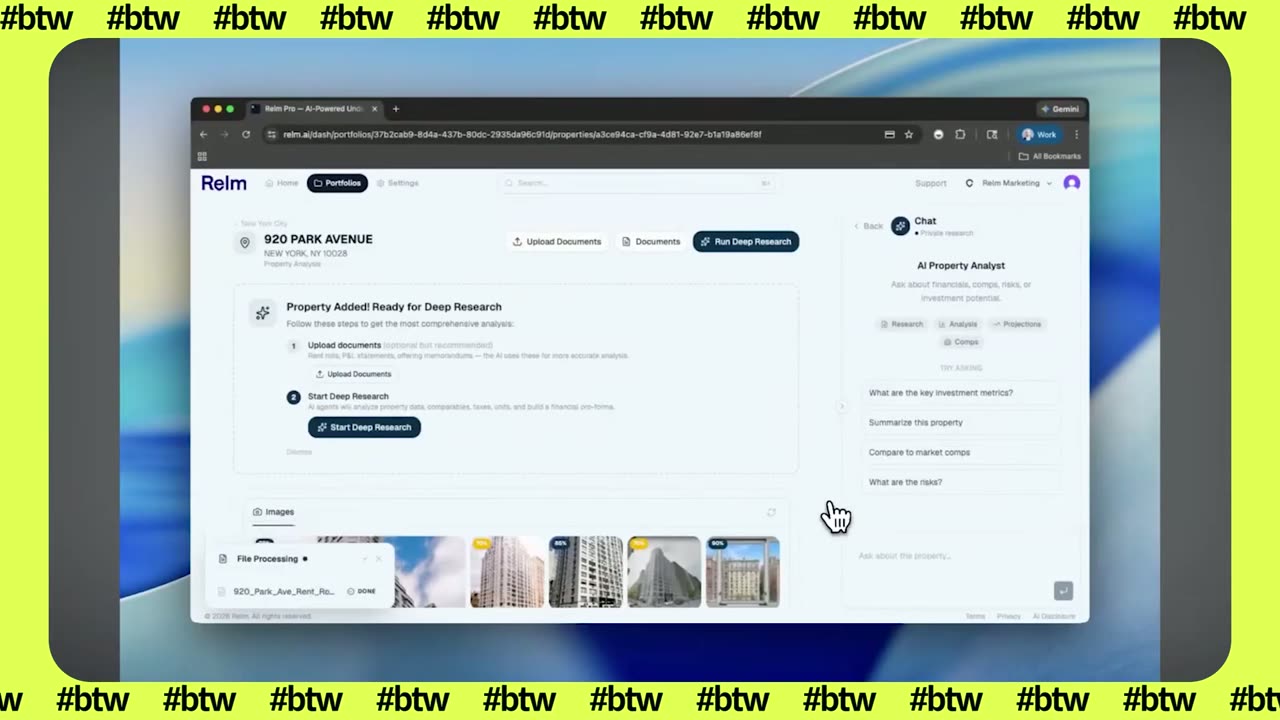

Watch Jackson Reiter demo Realm AI in Episode 47 (starts at 3:53) · Episode 47 notes and transcript
About half of Realm's clients are real estate investment firms looking to buy. Jackson describes the typical user as an analyst who gets 10 potential deals a week from a managing director and has to check whether the math works on each. Instead of taking two months to diligence those properties, he says, the platform lets them do all 10 in a number of hours.
The platform handles everything from tax information and ownership records to a full ten-year pro forma financial analysis. Realm's CTO, who has a finance background, led an Excel plug-in version, so dozens of AI agents can research any US commercial property directly inside Excel. Every data point comes with its source so analysts can go back and check.
The second product picks up when that analyst finds a deal worth pursuing. The Realm Report is a white glove, one-to-one service that goes 10 times deeper and produces a customized report on the property. Jackson's goal is for Realm to become a full stack real estate diligence firm, the node that connects every part of the transaction.
Sam asked whether Realm saves users from paying for 20 separate data services. Jackson says Realm uses a waterfall of data providers. It starts with direct partnerships with data feed companies, works down that chain, then supplements with public sources and direct connections to government sources. New York City, where Jackson is based, has led the way in putting its housing information online, and Realm connects to it directly.
There are limits. Coverage can be thinner for rural or underserved areas. And some data is off the table on purpose: Realm will not hand over a building owner's birth date, Social Security number or home address, and Jackson says it never would. For everything pertinent to a deal, he says, Realm can get pretty much all of it, with agents delegating searches to one another behind the scenes.
Sam asked the obvious next question: if Realm knows a firm's criteria, why not have it find and suggest properties? Jackson said the team spent a lot of time on that during its research phase and decided against it.
We will not do that specifically because, we genuinely and, wholeheartedly wanna make sure that we stay as the research partner, and we are a tool for them to do their research rather than a recommendation part of it.
— Jackson Reiter, Episode 47
The second reason is about the customers. Investment firms have their own processes and know exactly what they are looking for. Jackson says those preferences are the secret sauce firms see as their competitive advantage, so Realm leaves that to them and stays the tool they use to dig up the information.

Jordan asked Jackson to walk through the old workflow. Jackson says the residential boom coming out of COVID showed the whole industry that the jokes about real estate being pen and paper were true. He recalled a sophisticated investor with a wide portfolio, buying a commercial property in New Jersey:
he was using a, and I'm not joking, a printed out spreadsheet, like pen and paper, doing math with, like, a button calculator on the side. That's what the industry was like not even five years ago.
— Jackson Reiter, Episode 47
The industry has modernized since then, but Jackson says most of that has been simple digitization. Firms of every size love Claude and use it for basic automation, yet the work still happens in Microsoft Excel. The data step is a Google search: find the tax assessor's portal for Jersey City, download a PDF of the page, and type the values into a spreadsheet by hand. We saw a similar shift away from manual diligence in private equity on Episode 31.
With a marketing background, Jackson planned a narrow launch. Realm's platform handled every asset type from day one, but the team positioned it for multifamily investors because the buildings are relatively simple to model and those investors do higher volume. It worked, but people in their network who worked in mixed use and industrial were eager to use it too, and the user base now spans many asset types.
The bigger surprise was firm size. Realm works with some bigger firms, but the most value goes to small and medium investors: offices with two principals, three analysts and one capital advisory person, competing for deals against firms with 100 analysts.
Well, they have three analysts, and they're getting to the deal table quicker with an offer because they're able to model things quicker, with better data.
— Jackson Reiter, Episode 47
Big firms adopt slowly because of their layers of complexity, he says, while smaller ones find Realm, implement it in a couple of weeks and are ready to go. Jordan called it exactly the kind of AI use case the show is about: small businesses using AI to do what they previously could not. For more on how AI is changing property work, see our AI in real estate page and the home inspection demo in Episode 49.

Jackson demos the Realm platform on screen, and the news segment covers the SpaceX IPO and its Cursor deal. Watch Episode 47 of Built This Week, where the full transcript is also on the page, or read more about Jackson Reiter.