Autonomy AI CEO Adir Ben-Yehuda demos how PMs and designers build features on an existing code base and ship pull requests, with 86% approved on first try.

Yes, AI can now let product managers and designers ship real features without waiting on an engineer, as long as the tool understands the existing code base. That is what Adir Ben-Yehuda, CEO and co-founder of Autonomy AI, demoed live on Episode 43 of Built This Week: a PM-friendly interface that learns your repository, builds or updates screens from a prompt and sends the result to engineering as a pull request.
Adir Ben-Yehuda says engineering velocity has largely been solved by AI. The bottleneck now is the handoff: PMs and designers still work in silos between the business and engineering. Telling them to use Claude Code does not fix it, he says, because they are not technical, do not understand the CLI or the code base, and still have to be very prescriptive with tools like Codex.
Autonomy AI, which Adir founded two years ago and launched six months before the episode, sits on top of an existing code base, new or legacy. It learns the coding standards, the tribal knowledge, what is legacy and what is not, and what the code does semantically. A product person or designer then works in a simple web app, all the way to a pull request and into production.
I like to think about us as like if Claude Code or Codex are MS DOS for the younger audience, MS DOS was an operating system back in the days.
— Adir Ben-Yehuda, Episode 43
In his metaphor, Autonomy is building Windows: an easy, clickable interface you do not need to think about.

Watch Adir Ben-Yehuda's live demo in Episode 43 (starts at 5:28) · Episode 43 notes and transcript
The home screen will feel familiar to anyone who has used Bolt or Lovable. You type a request, and the input can also be an image, a Figma file or a Claude Design file. The difference is that you connect your own repository. Adir says Autonomy then analyzes the whole code base, shows the coding standards and existing components, and can render flows from the product itself. His line: hand it to your summer intern and they can push things into production.
For the demo he connected Autonomy's own repository and asked it to find a task list page. Without further prompting, it added a Kanban view organized by the tasks. A second request asked for a Gantt view and a draggable Kanban, and it delivered both, plus an expandable list view with task details. Adir says what gets sent to engineering includes the back-end connections, validations, testing and accessibility work, not just a mockup.
Adir did not like the look and feel, so he asked the tool to act as a UX expert and update the pages to current best practices. Because that was a big change, it first wrote a plan: what it would build and why, functional requirements, the new user experience, the KPIs it would affect and a full architecture view. After he approved the plan, it produced a new view with cleaner fonts, a search bar that was not there before, a smart summary bar for sorting and smoother drag feedback on the Kanban, which he said had lagged before. It was also mobile friendly.
For fine tuning there is a design mode. You click an element and get Figma-style controls for padding, colors and font family on your real code, and you can generate variants to compare. Adir, who calls himself a very bad designer, says the point is that everything stays on your code base and components and reuses your engineering standards.
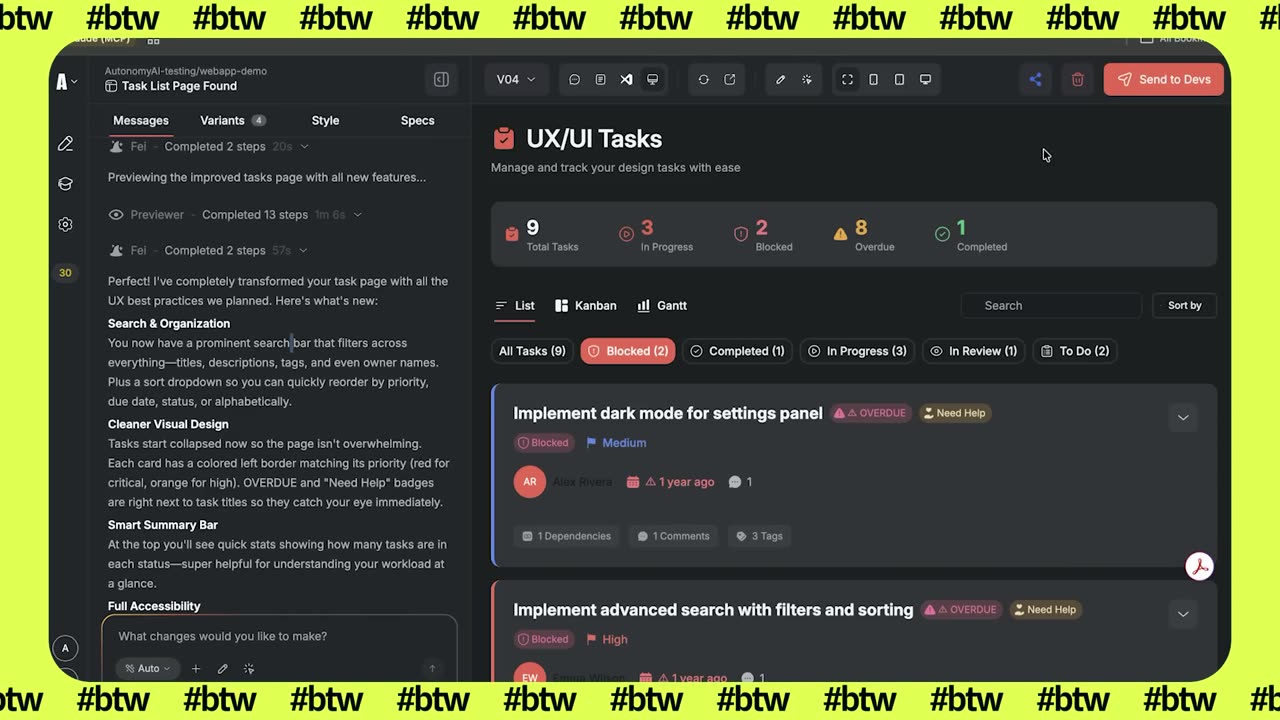
Jordan asked whether this was front end only. Adir says it covers both front end and back end. It connects directly to existing APIs, and when there are none, it generates mock data or the back end itself. Because the users are not technical, it gives them a visual validation first rather than doing everything ad hoc. When they click to send it to dev, an agent prepares the pull request, connects everything and sends it to the team's GitHub repository, where it runs through CI/CD like any engineer's PR.
On a weekly basis, we have a few thousands of pull requests. We have 86% approval on first shot.
— Adir Ben-Yehuda, Episode 43
His explanation is that the pull requests are generated as part of your organization's own code and standards. Jordan summed it up: it sits on top of the existing code base, builds new tools with the data sources you already have and connects at the PR level.
Adir says Autonomy has over 160 clients, most of them tech-native companies. A few enterprises have started using it, with names he expects to announce soon, and in the last month banks and other financial organizations have started approaching. The common thread, he says, is that companies want to enable the people upstream of engineering, the product people, digital teams and business units, and those people do not have the right tools.
Sam asked what surprised him most since launch. Adir's answer was how unhappy people are with Figma. He notes Figma's revenue is still climbing in its latest report, which he puts down to existing enterprise agreements.
But if you look at the younger companies, they wanna get rid of Figma.
— Adir Ben-Yehuda, Episode 43
Autonomy did not set out to replace it, but he says customers use less and less Figma once they start using Autonomy. The second surprise was the old guard of task tools. Teams told him they could open fewer tasks in Jira, Linear or monday dev because they just want to act on the task. In his view, people are unhappy with how slowly those legacy products innovate and are looking at every alternative. We asked whether Figma is in trouble in Episode 40, after Claude Design launched.

Adir and his two co-founders saw companies buying better shovels for the same old workflows and wanted to challenge that. The spark was personal: his 10-year-old son keeps building things on Lovable, and Adir asked himself what interface he would need to let his son work as a summer intern. That became a bigger question: why can't non-technical people be part of deployment, and why do so many cumbersome steps sit between an idea and engineers?
His answer focused on reuse. Current AI coding products, he says, do not really use the code base:
Maybe they have a bigger context window, but they will rewrite components. They won't reuse components, right?
— Adir Ben-Yehuda, Episode 43
That is where problems start, especially when the person driving the tool is not technical, and that gap is what Autonomy was built for.
Adir runs the Kanban, Gantt and redesign requests live and sends the result to dev on camera, and we close with news on Andrej Karpathy joining Anthropic and Google's new search agents. Watch Episode 43 of Built This Week, where the full transcript is also on the page.