Standard AI CEO Angie Westbrook on using store security cameras for online-style retail analytics, faster in-store A/B tests and a visual engagement score.
Computer vision can give physical stores the kind of analytics online stores take for granted, by running on the security cameras they already have. That is what Angie Westbrook, CEO of Standard AI, described on Episode 21 of Built This Week. She says some Standard AI customers reached statistical significance on an in-store change within three weeks, using only a couple of stores.
Before the interview, Jordan showed a tool we built with Standard AI in mind: a retail mood DJ. Jordan has been generating music with Suno and has tried Udio and ElevenLabs APIs. His observation is that most clothing stores play whatever is popular, whether the store is busy or empty, morning or night, rainy or sunny. So he generated five songs, from 90 BPM up to 130 and back to 100, each mapped to how many shoppers are in the store, moving from opening mode to a packed store and then to closing mode. Sam's thesis is that tempo might influence sales, though the right music likely depends on what you sell: a candle shop may not want 130 BPM, but a sunglasses shop might. The build is on our AI retail DJ page.
Angie liked it, and connected it straight to her product. You can't always see an instant reaction in sales data, she says, so Standard AI would track what shoppers actually do when the music changes and whether it creates more browsing. Jordan suggested going further: test individual tracks within a style and keep iterating until one maximizes yield, instead of every store playing the same holiday playlist.

Watch Angie Westbrook on Standard AI in Episode 21 (starts at 9:47) · Episode 21 notes and transcript
Angie says Google Analytics gave online businesses rapid A/B testing and personalization, while physical stores could only look at sales data, which is swayed by seasonality, traffic and weather. For anyone working on store layout, merchandising, marketing or in-store media, it has been very hard to know with real data how those choices perform.
You think about physical retail and brick and mortar, it's just been this black box. Right?
— Angie Westbrook, Episode 21
Standard AI deploys computer vision on existing security cameras to bring the same level of data fidelity that drives online decisions into the store. She says that matters most for retailers with both an online and in-store presence, who can now compare similar metrics in both places. You can learn more at Standard AI.
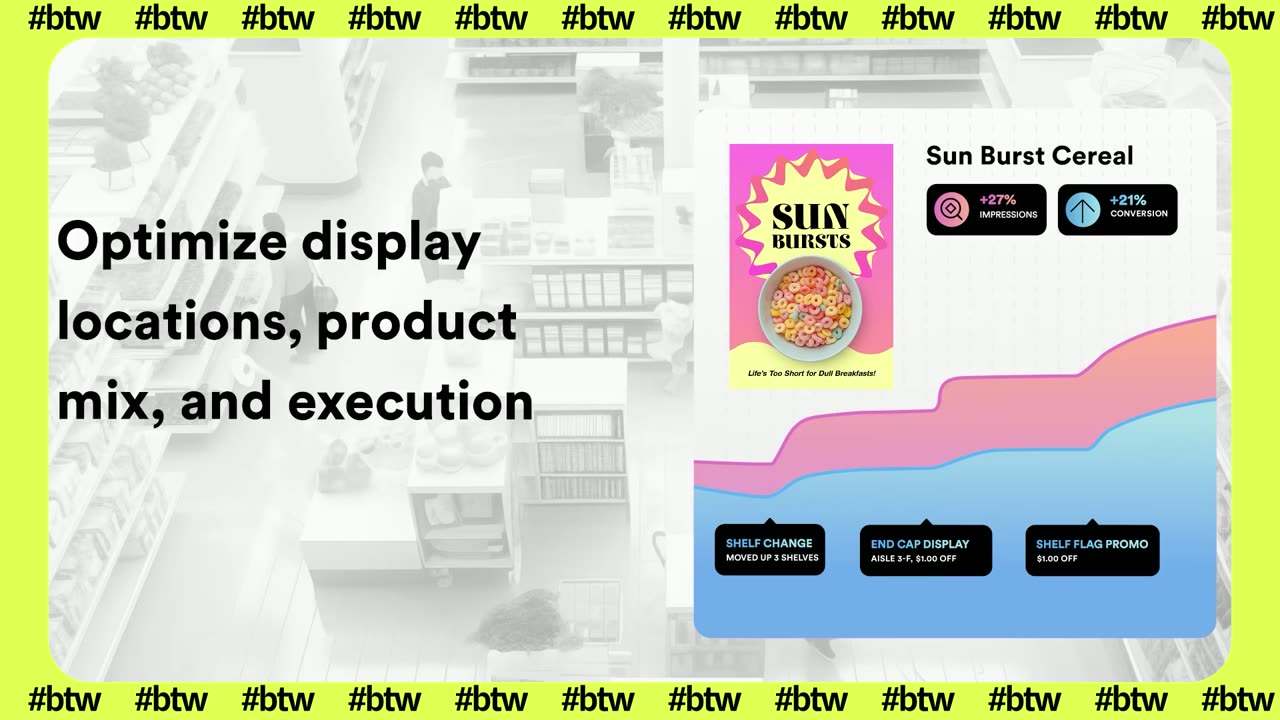
Angie calls herself an operations nerd who preaches leading indicators over lagging ones. Transaction log data can arrive weeks later, and it is a lagging signal of how shoppers respond. She describes the traditional in-store test: set aside around 40 stores, make 20 the control and 20 the experiment, and run it for 12 to 16 weeks. Even then, she says, you have to squint to tie any lift to your decision.
With ours, we've had some of our retailers and our customers be able to get to statistical significance on feedback of a change within three weeks and using only a couple of stores in some instances.
— Angie Westbrook, Episode 21
Speed matters in both directions. If a change works, waiting 16 weeks to roll it out is a loss. If it hurts, the customers in the test stores had a worse experience the whole time.
No. Angie says the system is built privacy first and does not use facial recognition, even though some vendors do. Its proprietary algorithms label about 26 points on a person's body, turning every shopper into a digital stick figure. That lets the system tell people apart without being able to identify who they are, because the labeled points are not like a fingerprint.

She says this is richer than what some vendors offer. Instead of measuring dwell time and assuming that anyone standing in front of a display engaged with it, Standard AI follows how people move and where they are looking.
Angie describes the visual engagement score as the in-store version of a digital impression: did someone actually look at your display or product? Her favorite example is a new product launch.
But I think it's, like, more than 85, 90% of the time a new product fails, and all you do is get the sales data that says it didn't sell.
— Angie Westbrook, Episode 21
The engagement score fills in the middle of the funnel. Lots of engagement without sales points to a product or pricing problem. No engagement points to placement, marketing or signage. Jordan asked how AI has changed the business since it started in checkout-free retail. Angie says computer vision breakthroughs are what make it possible to process that much camera footage at all, and that the longer it runs in a store, the more it can support predictive models that simulate changes before making them. She added that most retailers still see something like 85% to 90% of sales happen in the store. We collect more conversations like this on our AI in retail and ecommerce page.

In the news, Sam shared that Gamma, the AI presentation tool, raised a $68 million Series B at a $2.1 billion valuation and is profitable with a team of about 50. Jordan read out the rest as reported: Andreessen Horowitz leading, $100 million in ARR, 70 million users and 30 million gammas created every month. He expected Google and Microsoft to own this space and sees Gamma as proof that a startup can build a niche fast. Sam says it answers the question every founder hears, "can't Google build that?": they could, but sometimes won't or can't move fast enough. Angie sees Gamma as a rethink of how decks get made, not just a PowerPoint replacement, and as an operator she liked the focus on profitability after the growth-at-any-cost years.
The episode also covers SoftBank selling its Nvidia stake to back OpenAI and the ElevenLabs Iconic Voice Marketplace, where Angie says consent should be at the forefront. Watch Episode 21 of Built This Week, where the full transcript is also on the page, or read more about Angie Westbrook.