AI One's Emanuele Melis on starting enterprise agents at zero autonomy, which workflows suit them, and what we learned testing Anthropic's new Fable 5 model.
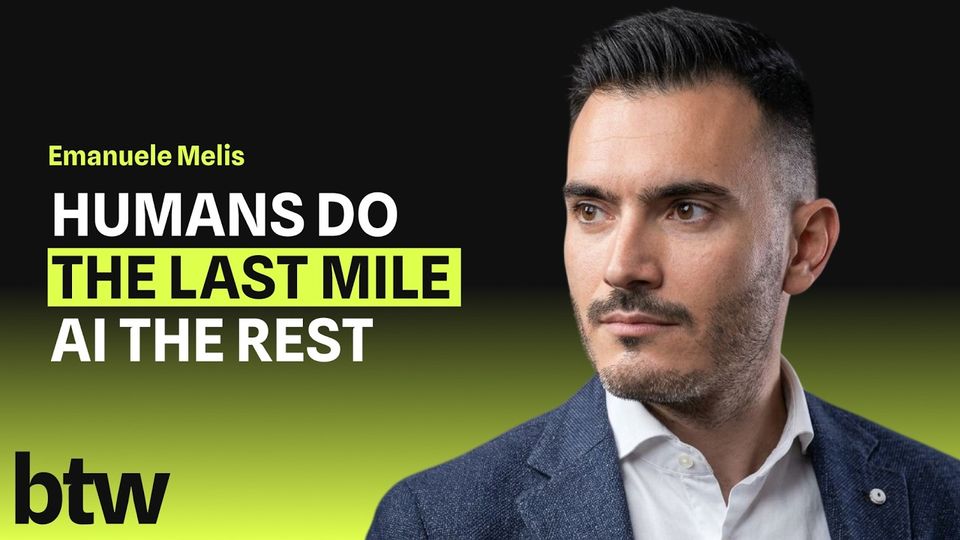
Enterprises can hand slow, multi-team processes to AI agents without a large data transformation program, as long as the agents start with no autonomy and earn it over time. That is the approach Emanuele Melis, lead field engineer at AI One, laid out on Episode 46 of Built This Week. His team installs Context One, AI One's context layer, and builds a customer's first agent use cases on top of it. We also shared our first impressions of Anthropic's Fable 5.
Emanuele asked us to imagine onboarding as a customer at a large enterprise. You fill in a questionnaire, it goes to team A, then team B for other checks, then team C. If team D finds an error, it has to go back to team A, then back to sales, then back to you. He says something very simple ends up taking a whole month.
His team's finding is that most of those handovers between people are unnecessary. Software and agents can cut through a good portion of those scenarios, and the human only comes in at the very last mile. AI One started about two years ago on the belief that enterprises don't need a large data transformation program to start benefiting from AI, so it built Context One, a context control layer that sits between enterprise systems and gives LLMs and agents accurate, governed context.

Watch Emanuele Melis on enterprise AI agents in Episode 46 (starts at 8:31) · Episode 46 notes and transcript
The autonomy slider is AI One's way of introducing agents safely. Emanuele put it simply:
You start every agentive workflow with the autonomy slider set to zero. So the agent really has no autonomy.
— Emanuele Melis, Episode 46
At zero, the agent drafts things, does research and presents its work, and a person takes the next action. Over time the agent and the people around it build confidence, the knowledge lives in Context One, and the slider moves right: maybe 5%, maybe 10%. Emanuele says it may never reach 100%, and that is fine. What matters to a large organization is what happens at 30% or 40% autonomy, when the change starts to show up in people's everyday work.
Sam asked whether a particular process or industry stood out. Emanuele said enterprise size is usually where the need shows up, and then described the kind of work they go after:
But what we target is mostly high complexity, low judgment use cases, which basically means something that is very difficult but does not require the human judgment to be completed.
— Emanuele Melis, Episode 46
He contrasted this with how software has handled edge cases for decades. A computer process fails, so you add a rule. That rule fails, so you add another. Ten years later you have 150,000 rules to fall back on. In his experience, an agent deals with the nuance and the edge cases much more quickly than a set of rules would.
Jordan asked for a real use case. Emanuele's favorite is one he never expected to see deployed in a regulated environment. A customer sends an email, usually about money, and someone has to investigate what happened on the back end. The customer wants an answer right away, and the investigator has someone over their shoulder asking for the root cause, who needs to fix it, and when and why it happened.
With agents, the work splits up. One agent pulls the transactions from the transactional database. Another checks the documents for an edge case that should have been taken into account. A third reads the logs to see whether the monitoring system missed a failure. Emanuele says that after a couple of hours, instead of what used to be a week of work, a person has a report with every data point needed to reply to the customer. The agent could draft that email too, but the real gain is that nobody has to sit at the keyboard querying each system. Agents can also run many hypotheses at once, much faster than a person.
On the lighter side, Emanuele's favorite personal use is coloring pages. When his kids want to color a dinosaur on a space shuttle, he asks ChatGPT for a PDF of it.
For his demo, Emanuele showed a game he built with Fable. He remembered a contraption puzzle game from the early nineties but could not find it or recall its name, so he described it to Fable and asked for a web version. In the game you place objects like a trampoline to bounce a ball into a basket, and after a few tries live on the show, it worked.
What's crazy to think about it is that a year ago, this would not have been possible, but today with Fable, literally took five minutes to put this together.
— Emanuele Melis, Episode 46
Jordan said the impressive part was not the puzzle itself but the physics. The ball bounces off a trampoline, flat wood or wind the way the game expects, and getting real-time physics right on a first attempt is hard for a model.
Jordan's daily driver is OpenAI Codex 5.5 on extra high, alongside Claude and Cursor. When Fable came out he put it on the highest setting, which starts sub agents, and his spend went up so fast he had to turn it down. When he tried running it with sub workers, he was told almost immediately that he had run out of tokens. His complaint is that there are too many effort levels with no clear explanation of the cost and speed trade-off, and that no tool warns you before a command will cost $100 when a $5 version would do.
It is also slow. Jordan started runs before World Cup matches and checked at half time, and it was sometimes still working at the water break. But he found it accurate: it caught security errors and bugs in his apps and implemented features and libraries predictably. After seeing a tip on Twitter, he told it to 100x the design and says the results were world-class web and app design. A second 100x only made it marginally better.

Jordan called it a classic Jevons paradox: as tokens get cheaper, consumption goes up. With more tokens he builds more apps, crazier apps, and has more ideas. He remembers Cursor a year ago leaving markdown notes with random numbers and no context. Now he starts a task, watches half a soccer game and comes back to finished work.
Emanuele agreed. In May last year he bet he could go through his engineering career without looking at a line of code; he admits he still has to for the most part. But he called Claude Code, Fable and Codex's browser view, which builds a web app and clicks through the UI until it works, mind blowing. He expects people to use far more tokens on far more throwaway projects, and recalled a statistic that GitHub had to cap how many projects could be created, at around 25,000 by his memory. We heard a similar token argument from Ivan Lee in Episode 56.
Emanuele demos the Fable puzzle game and explains Context One in more detail on camera. Watch Episode 46 of Built This Week, where the full transcript is also on the page, or read more about Emanuele Melis.