Breeze founder Karim Malhas on why running voice AI agents is harder than building them: step agents, OTP checks in code, phone groups and partner-led growth.

Building a voice AI agent is no longer the hard part for enterprises. Running it is: controlling each step of the call, keeping security checks out of the model's hands and making thousands of calls a day without getting blocked. That is the case Karim Malhas, founder, CEO and CTO of Breeze, made on Episode 42 of Built This Week, where he demoed the platform live.
Karim Malhas opened the episode with the line that sums up Breeze:
Everybody's competing to get the best agent, the best latency, the best all of these things, but people are forgetting. Once you get this, how are you going to run it?
— Karim Malhas, Episode 42
He describes Breeze as Vapi meets n8n for enterprises. It is focused entirely on enterprise customers and grows mainly through partnerships, with a focus on the Middle East, North Africa and South American markets and an expansion into Europe. Breeze came out of stealth in April after what Karim called a tough year of building.

Watch Karim Malhas demo Breeze in Episode 42 (starts at 2:30) · Episode 42 notes and transcript
Karim's definition of a voice agent is simple: ears, brain and voice. In Breeze you pick a provider for each one. In the demo he chose Deepgram for the ears, a fast model from Cerebras for the brain and ElevenLabs for the voice, which he called one of the best and very fast. Breeze does not build its own models, at least not today. Karim's view is that the models keep getting better, so Breeze takes the middle layer, orchestration, and lets customers customize it.
The editor looks like n8n on purpose, though Karim says Breeze built all of it. Work is split into projects, because a single shared project "just doesn't work" in a big enterprise, a lesson from his time at one. Inside a workflow you add inputs (an outbound call triggered by an API, for example), parameters, webhooks, conditional path steps, database lookups and standard HTTP requests to pull data from a CRM. Version control and compliance checks are built in.
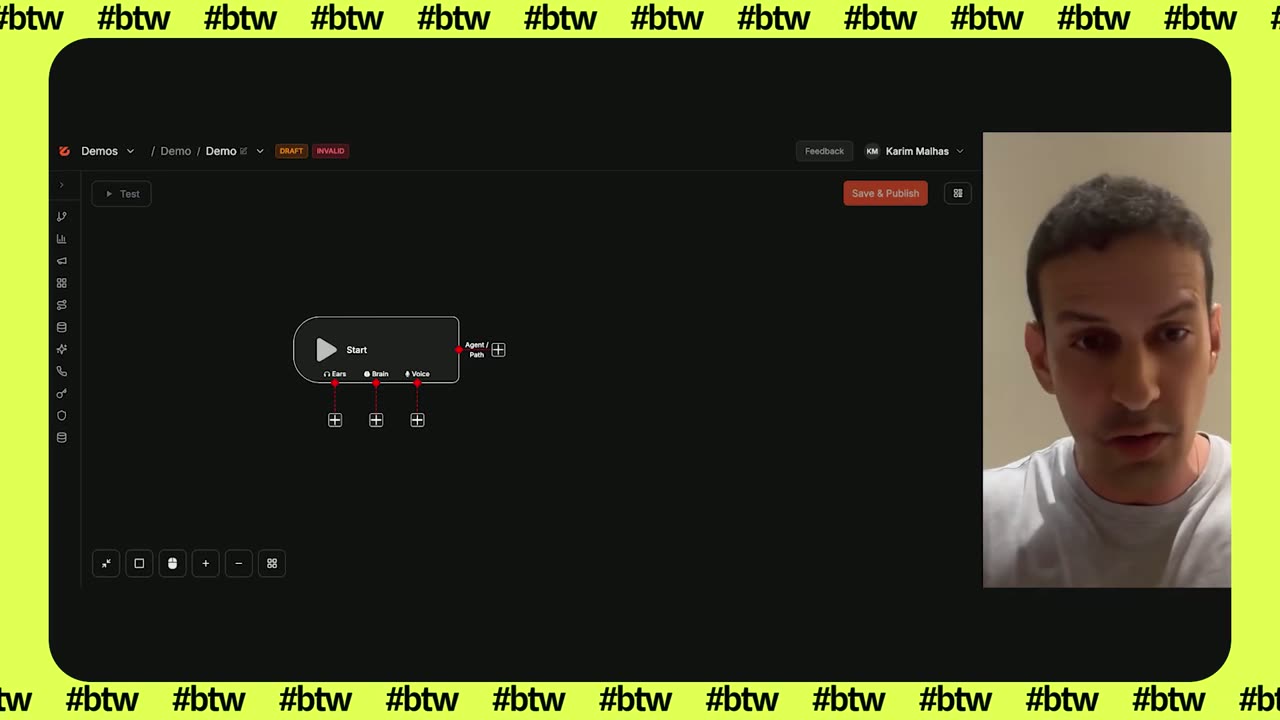
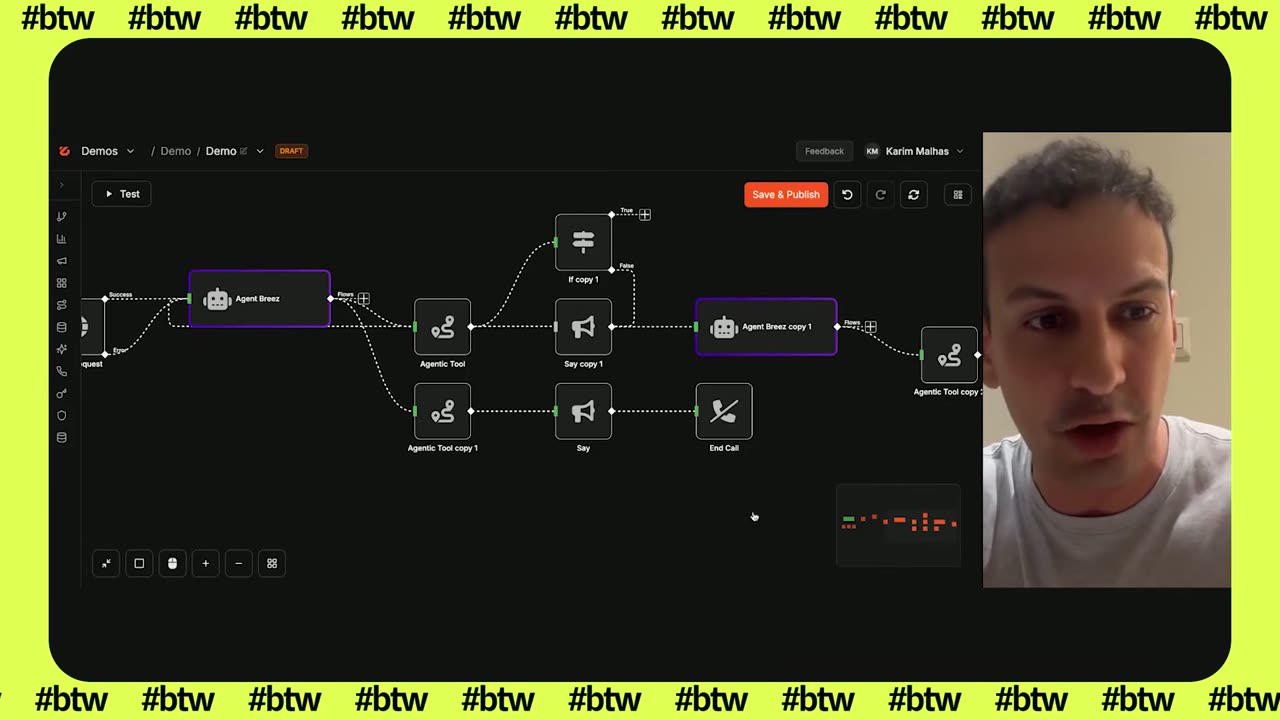
Karim says the problem with single-agent voice bots is that a big prompt makes the agent know everything, and sometimes you do not want that. Some steps cannot be skipped. So in Breeze an agent can have one narrow role. In the demo he built a consent agent whose only job was to tell the caller the call is recorded and ask for consent, with two tools: consent given, or consent rejected, which ends the call politely.
The next agent's only role was to collect an account number and repeat it back digit by digit before moving on. Agents can inherit a persona and the conversation so far, or start fresh. Karim's reasoning comes from how organizations already work: there is always a script, and people are scared of fully agentic systems. Structured outputs help too. For food delivery, for example, the agent can return a list of objects for menu items and their sub-items.
Sam asked about latency, which we have found to be a huge challenge when building voice agents. Karim's answer is that every handoff from one agent to another takes time, so Breeze only adds agents when it needs control, compliance or security. When he started building, he thought they would build everything as agents. Now he says you probably need two or three agents at most, and back-and-forth conversations like food orders work better inside a single agent.
His security example is an OTP check. The call starts, an API sends the caller a one-time code, and an agent that does not know the code asks for it. The comparison then happens in an if statement in code, which is deterministic. If it does not match, the flow goes back.
Because I don't trust the agent with giving it the OTP and making the comparison within the agent, cause there is always a way to jailbreak it.
— Karim Malhas, Episode 42
Karim studied cybersecurity and says he likes trying to break things. For raw speed, being provider agnostic helps: in the demo he pointed to model options at around 100 and 90 milliseconds.
Breeze does not think in single phone numbers. It uses phone groups:
if you think you're going to use one number to run 10,000 calls in a day, well, you're going to be blocked.
— Karim Malhas, Episode 42
You add as many numbers as you want to a group, and Breeze routes calls automatically. Its smart routing, which Karim says he learned from VICIdial, picks a local number for the person being called, a DC number for a call to DC, and selects randomly among them. On platforms like Vapi, he says, building that is on you.
Jordan asked whether the buyer is a local plumber or a bank. Karim says the ideal customer profile keeps evolving, but today it is COOs who want operational efficiency. Every first meeting starts with latency, accent and dialect. Dialect matters a lot in the Middle East, South America and Europe, where people do not like being called in a different dialect. Once that is settled, buyers see the real problem: someone has to run the agent. As Karim put it, he can hand over an API and a webhook, but the client's development team may take three months to finish a small project.
That is where Breeze steps in. Karim says the meeting shifts from whether the product works to how to run it. The team is 10 people, growing to 15 or 20, and he wants to keep it small, so Breeze scales through partners in the UAE, Kuwait and South America. He built billing that can be customized for every organization and a partner layer where each partner can hold multiple agreements, onboard clients, set its own prices and upload contracts for his approval. He calls this the operational layer of voice, as opposed to the infrastructure layer of SIP trunks, latency and concurrency, which he says Breeze has nailed.
In the news segment on Anthropic's reported fundraise, Karim called Anthropic a David taking on Google's Goliath. He then turned to work. He says he is a top 8% Cursor user in the world, runs a competition inside his company over who uses Cursor more, and pushes his team to use it more. His view is that the threat is not AI itself but someone who knows how to use it, even an 18-year-old.
He asks whether companies still hire juniors at all, since with these tools even people who cannot code reach a mid to high level. He predicts that within two years 80% of the world will be hurt and 20% will rise. That worry is why he builds Breeze from Jordan, the country, and the surrounding region: to show the next generation that knowledge is no longer limited to San Francisco. His own example: he now builds SIP trunks, something he was once scared to try.
Karim builds the consent and account-number agents live on screen, and Jordan and Sam share their take on Anthropic's valuation at the end. Watch Episode 42 of Built This Week, where the full transcript is also on the page, or read more about Karim on his guest page.