Jordan built a Kalshi prediction market trading bot with Claude Code and Cursor. It won 8 of 12 trades and still lost money. Here is what the build taught us.
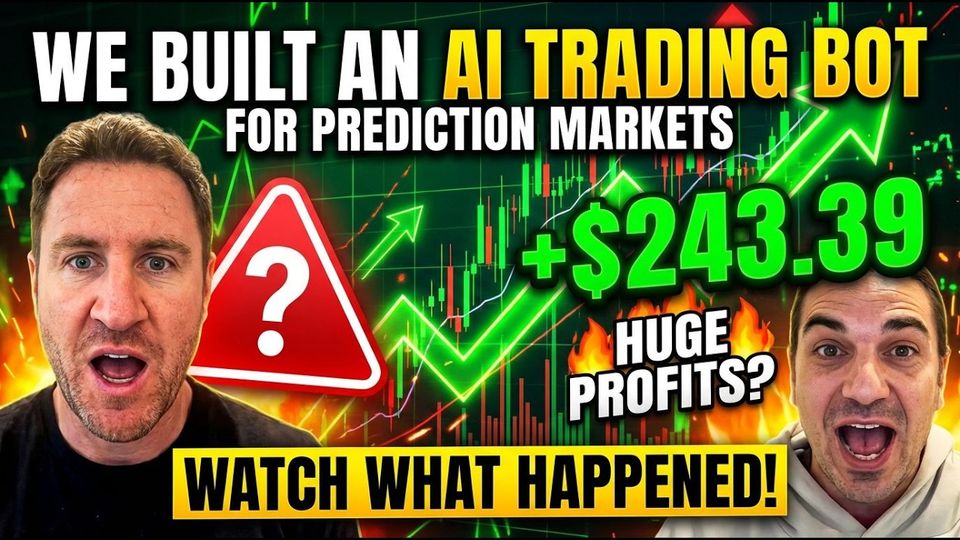
Jordan Metzner built an AI trading bot for Kalshi prediction markets over the holiday break, using Claude Code, Cursor and Opus 4.5 on Kalshi's API. It won 8 of its 12 trades and still ended with a small loss, because transaction fees ate the margin. His conclusion on Episode 26 of Built This Week: without inside information, he found no real edge to be had.
Jordan opened with context. Prediction markets were a craze in 2025, and beyond Kalshi and Polymarket he listed others moving in: Robinhood's deal with Kalshi, Coinbase launching a market, and Fanatics, FanDuel and DraftKings talking about their own.
His read on why: Kalshi and Polymarket found a format that let them sidestep state rules on online casino gambling and be regulated by the CFTC instead. Jordan lives in California, where online sports betting through FanDuel or DraftKings was not available, yet Kalshi is. In his opinion the experience is almost identical. The layout differs and you are supposedly playing against other traders, but he says it feels pretty close to gambling.
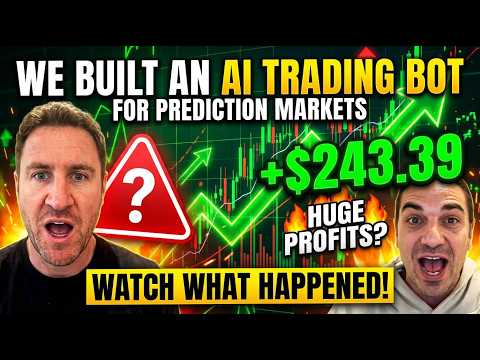
Watch Jordan build a Kalshi trading bot in Episode 26 (starts at 4:16) · Episode 26 notes and transcript
Jordan says he is not a good gambler and doesn't know much about sports, which he saw as an advantage: no hunches to get in the way. His first rule was fast feedback.
I need as close to real time feedback as possible because during development, I wanna know if like, my algorithm works, if I'm right or wrong.
— Jordan Metzner, Episode 26
That ruled out long-dated markets like the World Cup winner or the next presidential nominee. He wanted trades about to expire, and live sports fit, since games run all the time. He built the algorithm with Opus 4.5, Cursor and Claude Code. Polymarket is not available to traders in the United States, so he used Kalshi, which has a full API. The finished tool has a back end and a front end and connects directly to Kalshi. The build is written up on our Kalshi trading bot build page.
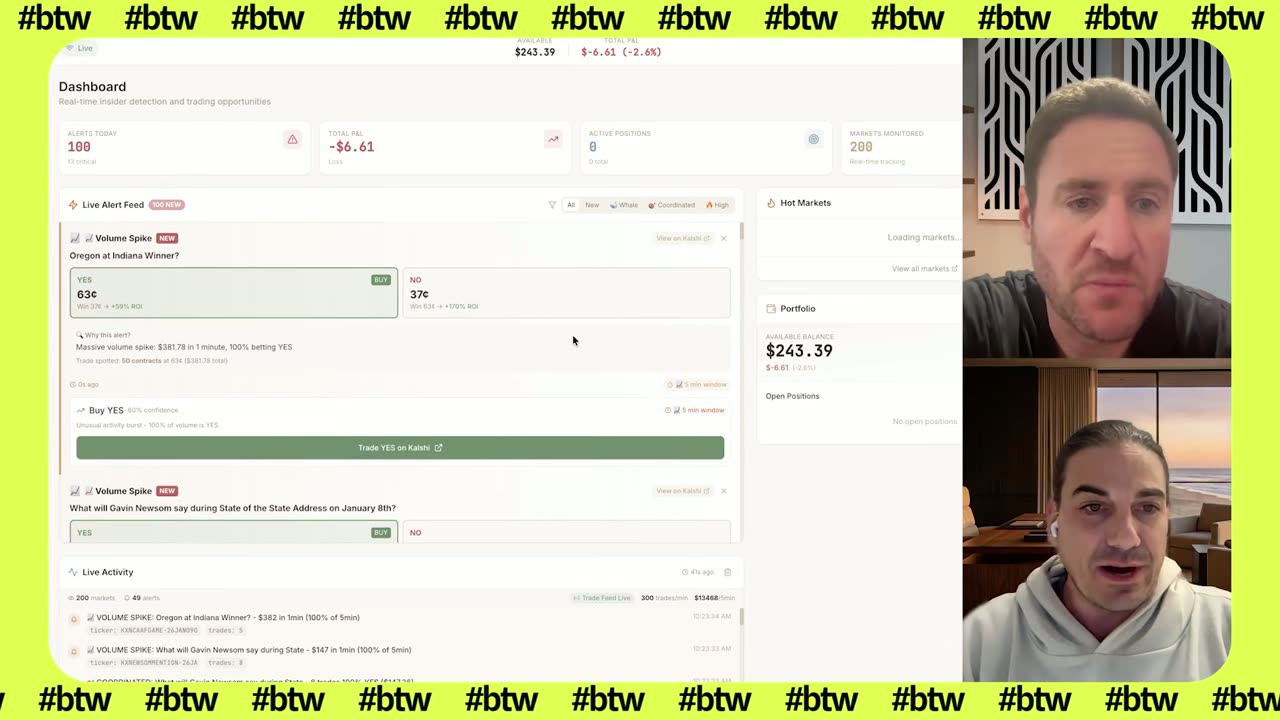
The core of the bot is a live alert feed watching every active trade on Kalshi. It flags spikes in volume, whale activity (high dollar bets) and coordinated entries, where many traders pile into the same side. One example on screen showed seven traders all betting yes on the same market.
Sam asked if the strategy was simply to follow the trend. Jordan said yes, and explained why: at a Las Vegas sportsbook you know the line, but not how many people bet in the last ten minutes. Prediction markets show that activity, and it can feel like some traders have information others don't. His bot tries to read that behavior.
A trading view gives every opportunity a confidence score, with filters by category (sports, politics, crypto, economy, entertainment), by signal and by expected return. There is even a QR code that opens the trade on your phone. During the demo the best score was 75, which Jordan said was not good enough. He wants 80 or above, ideally 90.
Jordan made about 12 trades, many on soccer games, and won eight of them, roughly a 66% hit rate. He still finished slightly negative, and only a small part of his deposit was ever traded. He gave two reasons.
First, transaction fees. He had not built them into the original algorithm, and on low-risk, low-margin trades the fees took away the margin. Second, bots trading on bots. If everyone trades on the behavior of the whole network, consensus drives more consensus, and even betting against it just creates a new consensus.
He did like one thing about sports: games start, stop and have a clear result, while some political markets leave gray areas over how an event is defined.
my biggest takeaway is that, the only real way to make money on these markets is to have inside information.
— Jordan Metzner, Episode 26
He called it a cool, fun, educational project and said he would probably take his money out and accept the small loss. Sam's view was that the hard part is finding signals that actually drive earnings, and that someone with real betting experience might take a tool like this further. This was a learning build, not a strategy we recommend. For another trading experiment, see the stock trading bot Jordan built on Public's API in Episode 8.
Our AI tool of the week was NotebookLM from Google. Sam says its strength is turning material into education content. Our onboarding knowledge has mostly lived in Google Docs, and some ideas come across better as an infographic or audio. He took one plain-text onboarding doc and NotebookLM turned it into a three-phase infographic in about five seconds.
He also heard from one of his daughter's teachers that students put their weekly notes into NotebookLM, generate an audio overview, and listen to it as a podcast while working out or walking. Jordan added that he has seen people of all ages use it, from doctors and scientists to students, and that Google keeps adding formats: video overviews, mind maps, reports, flashcards, quizzes, slide decks and data tables.

Jordan put that exact question to NotebookLM after building the bot. It pulled in a YouTube video, Kalshi's API documentation and an academic paper on arbitrage in prediction markets, then answered that consistent wins usually come from mathematical arbitrage or providing liquidity, not from betting on outcomes.
Jordan was skeptical of each route. On cross-platform arbitrage between Polymarket and Kalshi, he believes the fees are higher than the spread. He doubts same-platform arbitrage really exists in a meaningful way. Time arbitrage, like someone in a stadium trading before the score updates, he expects the markets to patch quickly. As volume grows, he thinks these become close to perfect markets, much like trading stock options. His opinion:
while Kalshi and Polymarket may say they're not a casino, they sure feel like the house, and it sure feels like the house always wins.
— Jordan Metzner, Episode 26
In the news, Sam covered Nvidia's move into autonomous driving with Alpamayo and its partnership with Mercedes. Jordan, a Tesla owner and fan of its full self-driving, said this puts Nvidia in an odd spot: Tesla's chip vendor and now its competitor. His reading is that Nvidia built the software so its customers would buy more chips.
He noted Elon Musk's public view that the last 1% of self-driving is a very long tail, and wondered whether Nvidia might give software away to automakers who buy its chips, which could matter if Tesla starts licensing its own system. Sam also shared that Nvidia's new Rubin architecture is reported to train models three and a half times faster than Blackwell and run inference five times faster.
We closed on Anthropic. Jordan said his developers were enthralled with Claude Code and Opus 4.5, and that a wave of tools, like the Ralph Wiggum plugin, was being built on top of Claude Code.
Jordan walks through the live alert feed, the confidence scores and his actual trades on screen. Watch Episode 26 of Built This Week, where the full transcript is also on the page.