Read AI CTO Rob Williams on why companies should capture every work conversation, 7-day data retention, 5 million users, and building AI products as verbs.

Companies should capture their work conversations now, because every day they wait, that context is gone for good. That is the case Rob Williams, co-founder and CTO of Read AI, made on Episode 54: put off capture for a quarter and you give up ninety days of context. He also explained how Read AI turns those conversations into daily briefings, why some customers delete everything after a week, and how to build AI products that get better as the models do.
Rob says he winces a little when people call Read AI a meeting notetaker, though he understands why they do. The way he frames the business is broader: Read AI captures the conversations people have throughout their work day so it can do useful things with them afterwards. What comes after the capture is the part he gets excited about.
His reasoning starts with cost. For many companies, he says, meetings are the biggest investment of time, energy and money they make. Read AI's goal is to get more out of that investment.
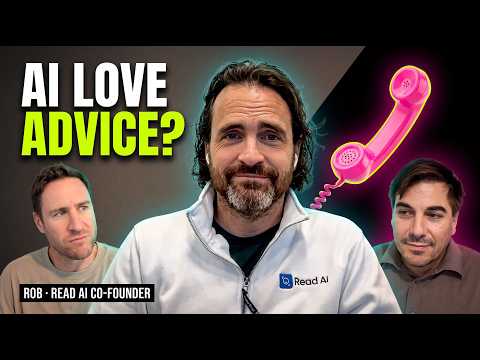
Watch Rob Williams demo Read AI briefings in Episode 54 (starts at 3:10) · Episode 54 notes and transcript
Based on user data and studies, Read AI started collecting the scattered conversations that happen inside a company, even one with 500,000 people, and using them to brief each person in the morning. Rob put it as wanting your context to be "hot and hydrated" so you walk into every meeting prepared.
He demoed a briefing live on the show. It was built from his email exchanges with us and what Read AI knew about our podcast, and it told him he needed to prepare a product demo for the call. So he showed it to us. The feature was rolling out to production over the following week, paced because Read AI has 5 million monthly active users.
Users can also shape where data goes. A folders view launched over the summer lets you set rules and actions so a client call flows to one group, while product discovery calls or user interviews go to a different set of internal people.
Sam asked about surprising use cases. Rob gave two answers. The first was not a use case but a pattern: people inside the same company vary widely in how comfortable they are with AI. Some think everything should be shared with everyone. Others are afraid the tool will take everything they know. Rob called handling that range one of the bigger product and go-to-market challenges Read AI has faced.
The second surprised him. Read AI offers retention controls, such as keeping data for 180 days or two years. When the feature shipped, some organizations set retention to seven days. Rob assumed he had misunderstood them. Their view was that data older than a week is more likely to lead people to be wrong than right, so they share it fast and then retire it. He had expected 30, 60 or 90 days to be the minimum, but some AI-forward companies move faster than that.
Sam later tied this back to Rob's roadmap: if an agent answers questions from sixty or ninety days of data, it could give conflicting or outdated answers. Rob agreed that deciding what supersedes old context is something the team thinks about regularly.
Jordan asked how the company got to that scale. Rob says it did not happen overnight, even if it looks like a blur in hindsight. Read AI grew within its market while the market itself grew. Most customers did not arrive asking to migrate from another tool. They came for advice on how not to miss the wave of productivity.
Meetings also carried their own urgency, which Rob believes sped up adoption:
Every day that goes by that you're not capturing the conversations that are happening within your organization is a day that those conversations are gone forever.
— Rob Williams, Episode 54
Jordan mentioned a client that until recently had executive assistants sitting in on calls as live scribes, something that would now seem absurd there. Rob has seen the same shift. Assistants have moved from scribe to something like air traffic control: reviewing meetings and deciding what information needs to go where. He called that the best case, since they keep their jobs and do higher-impact work. It was also useful product feedback, because that routing is what Read AI wants to automate.
When Read AI raised its Series A, investors gave the usual lean startup advice: pick a narrow focus. Rob says he agrees and disagrees. Read AI's narrow focus is the information worker, anyone whose work happens in meetings. A project manager, an accountant or a consultant all have the same need for continuity in their relationships and context, whatever the content of their meetings.
That approach led to industries he never expected when the company started five years ago. One early use case was oil fields in Africa working with offices in Asia, where Read AI shifted context across time zones so nobody had to get up in the middle of the night for a call.
We talk almost every week about how fast new models arrive, so Jordan asked what that means for Read AI. Rob's answer: build a verb, not a noun. Thirty years ago, software was a static product shrink-wrapped on a store shelf. Today, he says, a team building on AI models should build the machinery that keeps the product current:
Like the organization should be building the crank that we can turn to update the entire product line to take advantage of new abilities quickly as possible.
— Rob Williams, Episode 54
In 2022 and 2023, Read AI chose not to spend as heavily on prompt engineering as some companies did, assuming much of that work would be wasted. Instead the team built the rest of the product so that expected model improvements would add value for free. If the product is designed well, Rob says, you can hide model changes from users and swap new ones in.
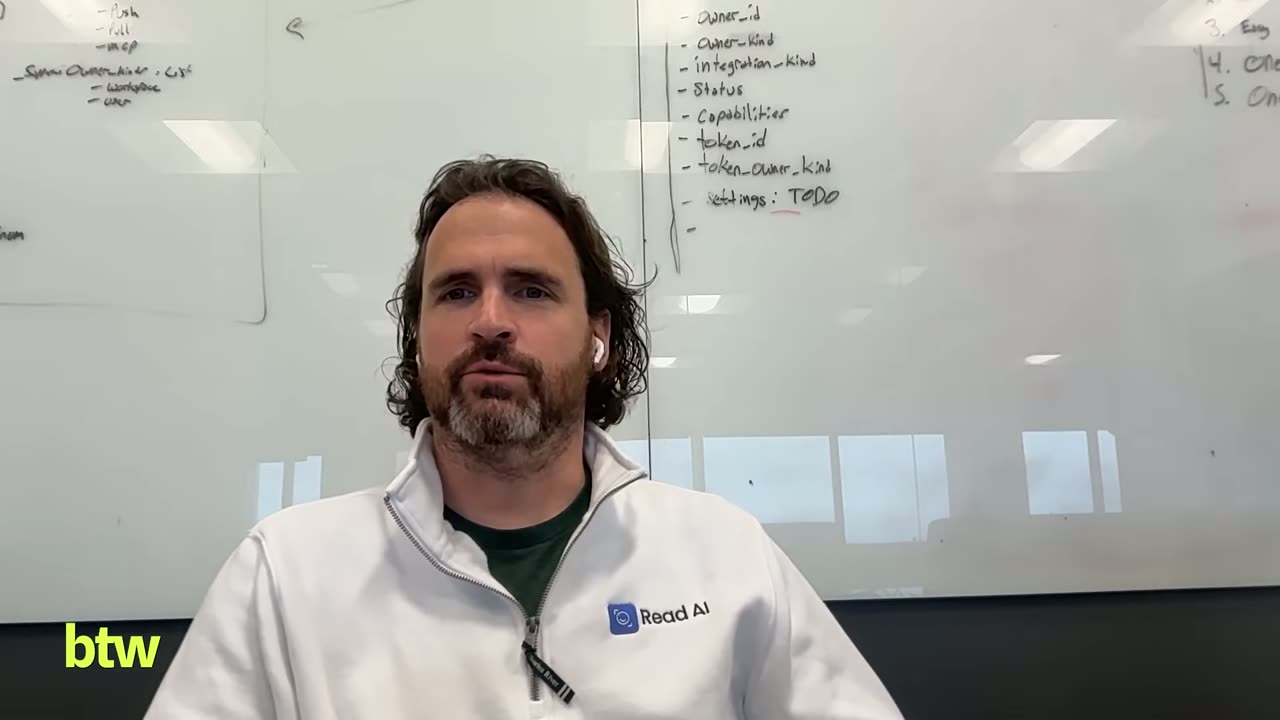
Rob says the priority for the next three to nine months is speeding up how information moves. He used a Slack message as the example. For Sam to get an answer from him, Rob has to be awake, at his computer, with Slack and that DM in front of him, and with an answer ready to send.
It's just such a big chain of dependencies that I think for the majority of questions, we can answer for you using all of the information that we already have.
— Rob Williams, Episode 54
He expects the hard part to be trust: getting people comfortable letting that information move. His prediction is that within about three years, companies that do not let information flow to the people who reasonably need it will be at a strategic disadvantage.
At the end of the episode, the conversation turned lighter. Rob admitted he once sat under his sink asking Claude why his garbage disposal was clogged, and Sam said he uses AI as a sounding board for big decisions. If you want meetings turned into tickets, we covered a tool for that in Episode 39, and you can find more on AI in productivity.
Rob's live demo, the full discussion and our take on AI relationship apps are all in Episode 54 of Built This Week. The episode page has the full transcript.