Edgevanta CEO Tristan Wilson on AI agents that read 1,500-page highway bid packages, extract bid items and mine DOT bid history for civil estimators.
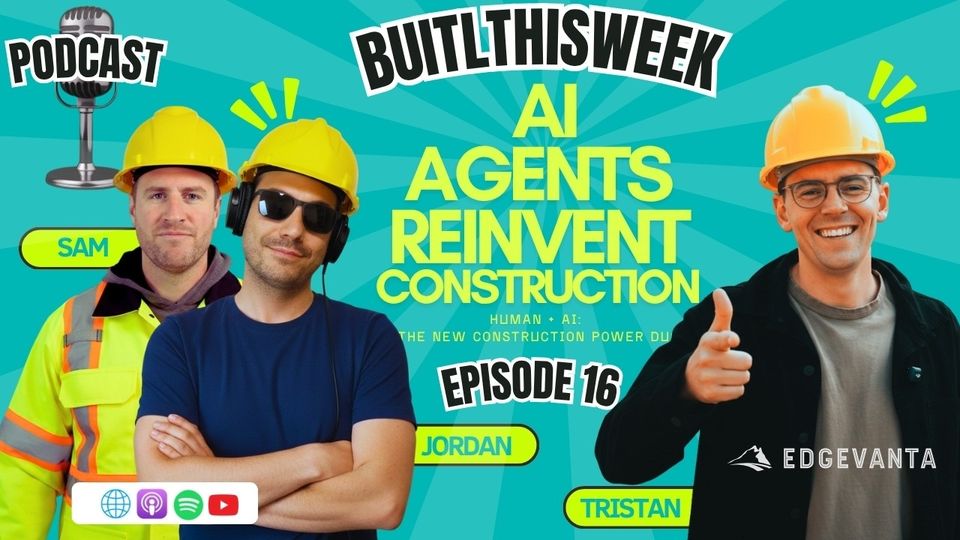
AI agents are changing civil construction estimating by reading the bid documents for the estimator: they parse packages that run to well over a thousand pages, pull out the bid items and the requirements that matter, and query years of public bid pricing. That is how Tristan Wilson, CEO and founder of Edgevanta, described it on Episode 16 of Built This Week. His company makes AI agents for civil estimating, and he says they make estimators faster and more accurate rather than replacing them.
Tristan grew up in the industry. He worked as a project manager and estimator at his family's road construction business in Louisiana. After the family sold the company, he moved to Nashville and started Edgevanta in 2022, built around the pain he felt going through stacks of bid documents.
Tristan Wilson says an estimator takes a pile of specs, drawings and bid packages and works out two things: what the scope of work is, and how much it will cost to build. Then the estimator has to fill out every form, requirement and schedule correctly to submit a compliant bid. Success means the owner accepts the bid, you come in as the low bidder, and if you win, the real cost in the field lines up with what you estimated.
The slow part is reading. His example is an estimator in South Carolina who gets a bid package from a county to widen a highway. That package can run 1,200 to 1,500 pages of specifications, bid forms and drawings, and the estimator has to physically read every page. Tristan says maybe 80 to 100 of those pages really matter. When he did this job, it took him four to six hours per bid just to review the documents, before any takeoffs or analysis.

Watch Tristan Wilson on AI bid document agents in Episode 16 (starts at 10:00) · Episode 16 notes and transcript
Missing a small detail can cost the whole job. Tristan shared his own horror story. He was the estimator on a $6.5 million airport bid and missed a requirement, added in a late addendum, that called for paperwork from subcontractors. The forms came in late.
And I submitted my bid, which was 6 and a half million dollars nineteen seconds late, and we would have had low bid and won the job.
— Tristan Wilson, Episode 16
He listed the costs as he sees them. A five person estimating team that spends 20% of its time on spec review is, in his estimate, a $100,000 a year investment. Missing one qualification can cost a million dollars or more of work. And on a lot of public work, he says, bidders leave about 8% on the table on average. What changed, in his view, is that AI can now parse and understand documents with close to human level accuracy, which it could not do a couple of years ago.
The estimator uploads the bid documents to Edgevanta, and a set of AI agents trained on civil construction data parse them and pull out the important information. The estimator then reviews the output as the human in the loop.
Tristan gave a small example from a visit to an estimator in South Carolina. She had three bid forms that were not formatted well, so the old way was to put the PDFs side by side and type every bid item into Excel, about two hours of work. With Edgevanta she uploads the documents, presses a button to run an agent built for that task, and exports the items to a CSV.
That two hours, gone. You can do it in a matter of two minutes.
— Tristan Wilson, Episode 16
The time goes back to the work that matters: figuring out how to build the job in the most cost efficient way and making sure the bid is compliant.
Low bid construction gives you one shot. Everyone submits, the bids are opened, and you either won or you didn't. A lot of money sits in the gap between first and second place, so pricing well matters as much as reading well.
Tristan says Edgevanta gathers historical pricing from Department of Transportation websites and brings it into the platform, where agents can query past bids. The questions are where the market is for this job, how much work competitors have, and what is likely to happen on upcoming bids. At his family's company, he says, one person did bid tab forecasting full time in Excel. With AI, existing team members can do that work.
He says the payoff was large. His family's company was leaving 11% on the table across its bids, which he says was tens of millions of dollars. Using better data, they brought that down to about 7%, which he says put almost $8 million back in their pocket.

Jordan asked whether faster bidding means firms can bid on more jobs. Tristan's answer was about the jobs they skip. Edgevanta's customers are civil firms that move dirt, put in pipe, lay pavement and build roads, and they get tens of bid packages a week, sometimes a day.
As an estimator, he remembers getting emails saying "look at this job," then downloading plans, often sideways, and clicking through to see if anything was relevant. Now an agent can return a structured summary that says whether the job matches what the firm normally bids, or whether it is, say, a medical building with nothing for them. He says getting 30 to 45 minutes back per package adds up given the volume. You may not bid more jobs, but you stop wasting time on the ones you won't bid.
Sam asked whether estimators push back. Tristan says reactions vary, and he has presented to rooms of project managers and estimators where there was a lot of fear. His answer is to define AI as a tool that makes the estimator better, not a replacement for the person working out what a job will cost.
Like, hand entering a 120 items does not make you a better estimator. All it does, it basically makes you spend time on stuff that doesn't matter.
— Tristan Wilson, Episode 16
He was clear that estimators still review every page and stay fully responsible for the job, and that knowing the old school way still matters. He also shared a case where an estimator had already reviewed a package in detail, and the AI still caught a conflict: the owner gave one completion time in one place and a different one deep in the contract. Catching that early can keep it from becoming a dispute or claim later. His rule of thumb for customers is to assume the tool they are using is the worst AI they will ever use, because it will keep getting better.

In the news segment, Jordan raised OpenAI's spending plans and asked Tristan for his view. Tristan said he thinks AI is massively underhyped. He sees OpenAI enterprise accounts becoming common in construction, and estimated that 15% to 20% of the firms Edgevanta talks to use AI across the enterprise, often because an enterprise account makes them more comfortable uploading sensitive information.
He says few tools are purpose built for civil construction, and the industry is traditional, so most firms sit in the early and late majority of the adoption curve and want proven products. Still, he says the executives he talks to use ChatGPT, maybe Claude or Grok, every day. For more on how the industry is adopting AI, see our AI in construction page and our conversation on construction procurement in Episode 33.
The episode opens with Jordan playing Edgevanta Tycoon, a bidding game he built for the show, before Tristan walks through the airport bid story and the agents in detail. Watch Episode 16 of Built This Week, where the full transcript is also on the page, and read more about Tristan Wilson.