Doss CEO Wiley Jones on building an AI-native ERP for physical product companies, why Doss bot improves with every model and how to sell past switching costs.

An AI-native ERP lets a company shape its software around its own operations instead of reshaping its operations around the software. That is the pitch Wiley Jones, CEO and co-founder of Doss, made on Episode 44 of Built This Week. Doss runs procurement, inventory and order management for mid-market companies that move physical products, and its agent, Doss bot, can read the system's own setup and explain how the business actually runs.
Wiley Jones started Doss about four years ago, and he likes to point out that the company was incorporated a month before ChatGPT launched. He left his job the moment he saw the jump from GPT-2 to GPT-3 and the capabilities that started to emerge. His joke: like all great Bay Area entrepreneurs, he looked at super intelligent AI and decided to build more enterprise software.
The serious reason comes from his background in hardware engineering. He loved making hardware products, but kept running into enterprise systems that forced the business to operate in ways he didn't expect. His one-liner for Doss is that it helps customers adapt their applications to the strategy of their business, not the other way around.
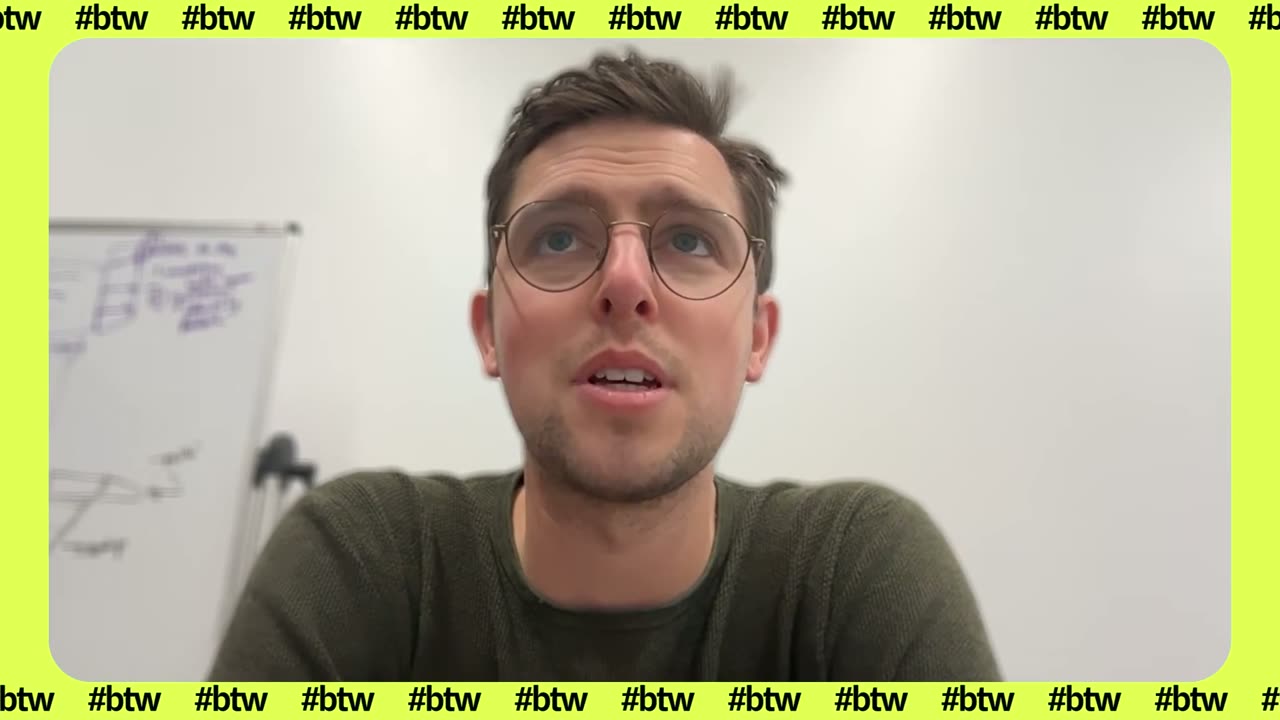

Watch the Doss demo in Episode 44 (starts at 2:46) · Episode 44 notes and transcript
Doss calls its product an ARP, an adaptive resource platform, rather than an ERP. Wiley says it looks and feels like standard enterprise software on purpose, but the building blocks are kept simple so applications can model themselves around what each customer needs. The core apps cover procurement, inventory management and order management.
His demo used a fake coffee company. Its product catalog doesn't fit a vendor's default data model: it wants to track grinds, and it has 25 variants of medium grind coffee alone. Doss handles this with what Wiley calls a dimensional data model that is highly composable. Creating a new SKU is a form you build much like you would in Google Forms, connected straight to the system's database. In his words, Doss helps customers manage the flow of goods, dollars and data. He says people often describe it as taking the best concepts of Airtable, Retool and Zapier and pointing them at ERP.
Wiley first showed raw speed. On a table of a million sales orders, he typed his name and the system found every matching record in a couple hundred milliseconds. He says doing that kind of search on top of a composable data model is technically very hard, which is why most business software shows loading spinners while queries run.
Then he handed that same data to Doss bot. Asked about the last 10 wholesale orders, it went and did what a person would do: pulled the sales orders, pulled the detail and assembled an answer. Wiley compares the agent to Claude Code or Cursor. It fans out across the system, collects the workflows and the data model, samples data from the tables and describes the business the way an agent would describe a code base.
And the beauty of this is that every single time the models get better, Doss bot gets better.
— Wiley Jones, Episode 44
The reason, he says, is architectural. Doss pushed the data model out of the code base and into the application layer, so the agent talks to the data model directly. That means Doss doesn't have to keep investing in system infrastructure and prompt engineering for the agent to get smarter.
Jordan noted that every company has some kind of ERP, so the market could be every company. Wiley says investors love hearing that, but the real work is concentrating the ideal customer profile so you understand a small segment deeply enough to change how they work.
The key, he says, is where a company sits in its maturity journey. Companies from about $20 million to $100 million in revenue think in binary terms: they want to win, grow revenue, enter sales channels and launch products. Larger companies, from $100 million to $500 million, ask how to build systems that compound over years. They usually already have a view on data warehousing, CRM and finance, so Doss has to figure out early where it fits in their enterprise systems roadmap. Today Doss targets physical operations companies from $20 million to a couple hundred million in revenue.
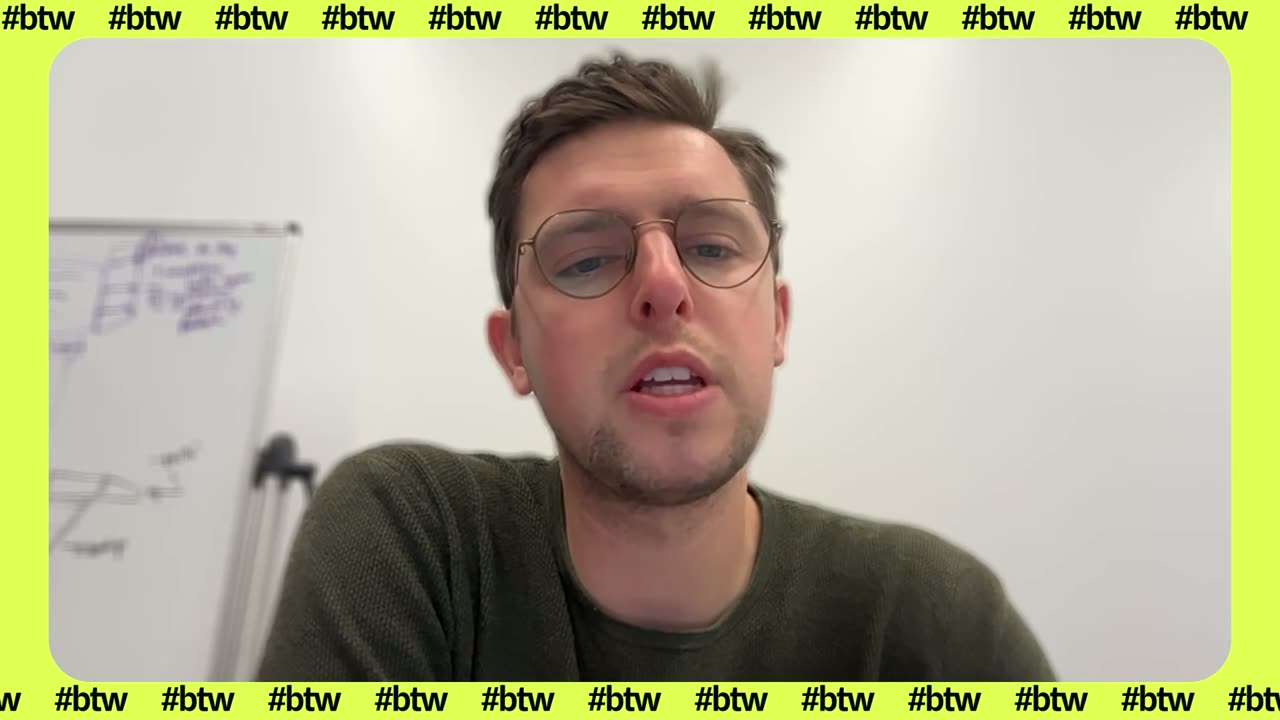
Sam asked whether long sales cycles and entrenched players make it hard to get customers to switch. Wiley's answer was direct:
Number one is that if you're fighting switching costs, then you are not qualifying customers properly.
— Wiley Jones, Episode 44
He compared it to a real estate agent complaining that moving is expensive. That is only a problem if you are talking to people who don't want to move. Wiley estimates that roughly 5% to 10% of the market wants to make a change every year. The better question is how to be in consideration when that happens: a business that grew from $5 million to $50 million in 18 months and needs systems to reach $200 million, a company that outgrew its current tools, or one that went through a material change like a sale or a new product line.
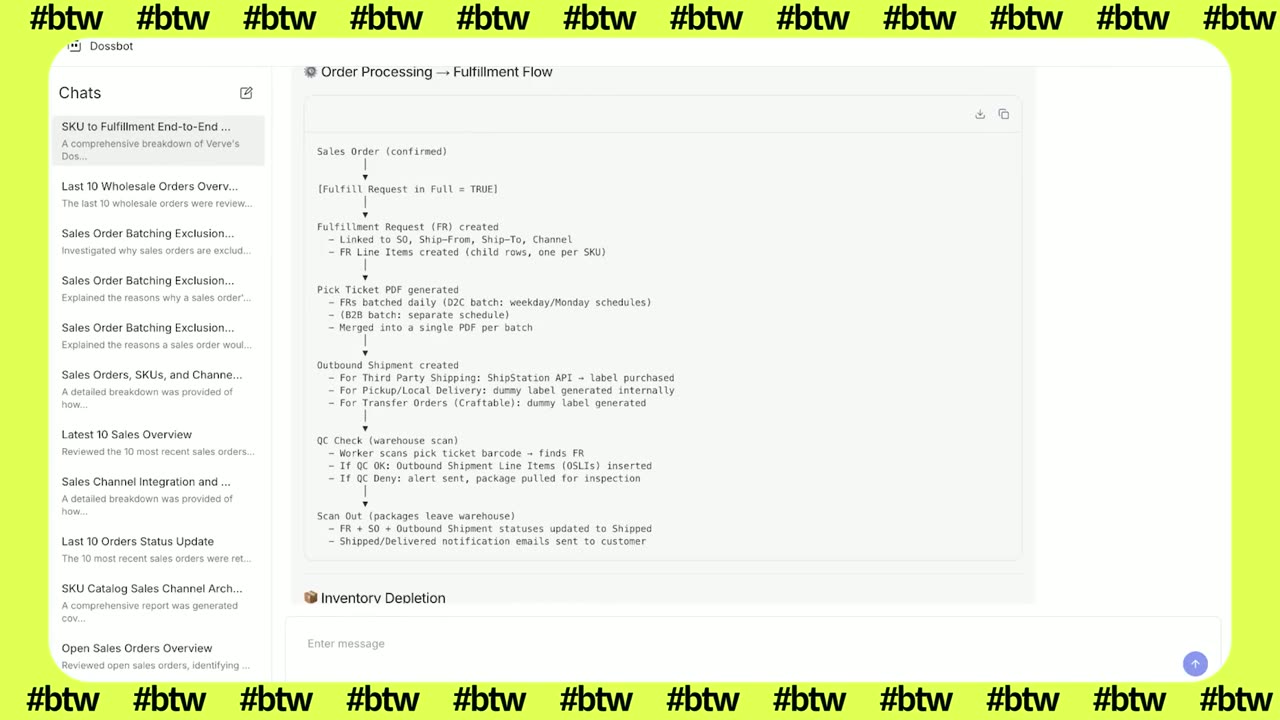
Back in the demo, Doss bot finished a much harder request: explain how the product catalog connects to SKUs, how SKUs connect to sales channels and how orders flow from sales order to leaving the warehouse. The answer went line by line through the workflows. It showed that third-party shipping uses ShipStation to buy labels, while pickup and local delivery orders get dummy labels so people know who the package is for.
So very, very detailed precise understanding of the system behavior and it's not reading documentation. It's actually reading its own implementation.
— Wiley Jones, Episode 44
Jordan called this exposing tribal knowledge, the kind of thing a few people know in pieces and nobody knows in full. Wiley put it slightly differently. Everyone has a mental model of how posting on Instagram works, but an operations system is far more complex than that. Doss bot takes implicit system behavior and makes it explicit, so people don't have to remember how the whole thing works.
In the news segment, Sam brought up Robinhood letting users trade stocks with AI agents. Jordan pointed back to Episode 26, where we used AI to trade on Kalshi (the Kalshi trading bot build), and to our episode with Public. Still, he doubts agent trading adds alpha: if everybody has AI, everyone ends up tied together. He sees more practical uses, like holding individual S&P stocks with daily rebalancing, or tax loss harvesting.
Wiley was more skeptical. He thinks a natural language interface for building a portfolio is useful, but worries it makes gambling and risky moves like shorting more frictionless for people who don't know what they are doing. He also joked about model bias, comparing it to asking Codex and Claude to review each other's work.
Wiley walks through the coffee company demo, the million-record search and Doss bot's full system breakdown on screen. Watch Episode 44 of Built This Week, where the full transcript is also on the page, or read more about Wiley Jones.