Vinci CEO Hardik Kabaria on how a ground-up AI physics model answers chip thermal and warpage questions in minutes, so engineers run thousands of analyses.
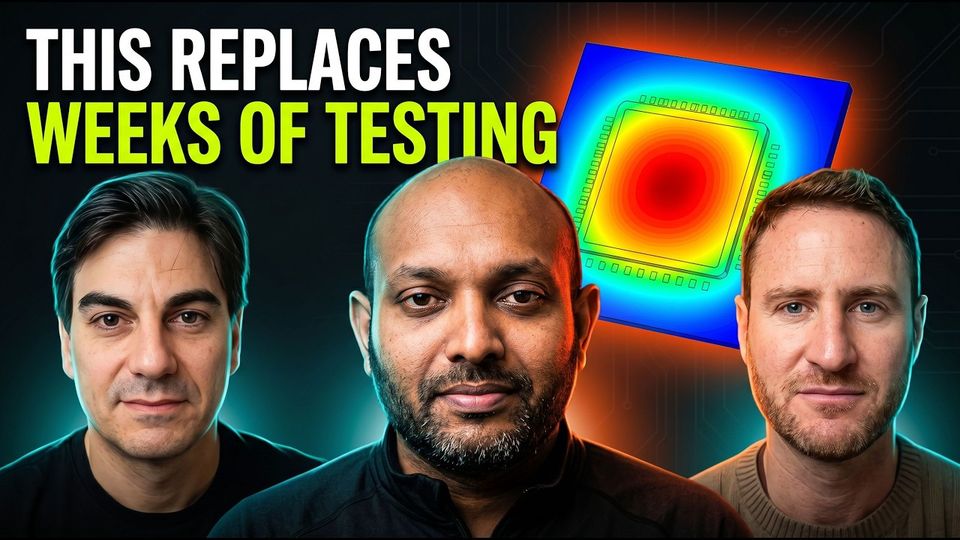
AI physics simulation lets chip and hardware engineers get answers to thermal and warpage questions in minutes or seconds instead of waiting a day or more, without needing a simulation expert to run the analysis. That is what Hardik Kabaria, co-founder and CEO of Vinci, explained on Episode 50 of Built This Week. Vinci trained its own physics model from the ground up and deploys it at semiconductor and electronics companies, where one thermal engineer can now run thousands of analyses a day.
Hardik Kabaria has a background in physics and geometry software and has spent more than twelve years in the field, including a PhD and other startups. He started Vinci about two and a half years ago with a simple mission: make physics accessible to everybody building hardware. Whether you design bottle caps, semiconductors or racks in a data center, he says, you care about how the part will behave physically from the moment you start designing.
He compares it to what language models did for text. You no longer need to be an AI researcher to get language reasoning; you open ChatGPT and ask. Vinci wants the same for physics, and it started with semiconductor and electronics customers. You can read more about him on his guest page.

Watch Hardik Kabaria on AI physics simulation in Episode 50 (starts at 9:08) · Episode 50 notes and transcript
Vinci's demo focused on warpage. In semiconductor packaging, bonds only form when warpage stays within a tolerance measured in microns. If it does not, there is no electrical connection. AI systems demand larger packages, more dies and denser routing, and as complexity grows, so does warpage. The demo says some of the industry's most advanced products have already been redesigned because warpage could not be predicted early enough.
The run shown in the episode analyzed the native design, every layer, metal line and via, at three-micron resolution and a 225 degrees Celsius bonding temperature. It covered 1.2 billion degrees of freedom and finished in under four minutes. The point of the demo was the shape of the result: the warpage follows the actual layout and metal distribution, which simplified models cannot reproduce.
Jordan asked how simulation is entering hardware. Hardik says physics simulation methods have existed since the sixties, and tools from Cadence, Siemens and Synopsys are used across the industry. But in the end, companies still design a part, prototype it, take it to the lab and run experiments to test their hypotheses. The bottleneck is how many people can run complex software or expensive experiments, and how many prototypes you can afford.
A tape out in semiconductor industry could cost millions of dollars and months.
— Hardik Kabaria, Episode 50
Vinci's customers are getting answers to thermal questions, like how a semiconductor part will heat up or whether a small change lets them raise the data transfer rate or power load, in minutes or seconds instead of waiting a day. Just as important, Hardik says, they do not need an expert to run the analysis.
Today the loop is slow. Someone designs the part, someone else evaluates its physical performance, someone checks manufacturability, and the work circulates. Hardik points out these people often sit on different teams and sometimes work for different companies, so iteration cycles run in weeks, not days. He made the gain concrete:
Now instead that engineer, she might be performing 10 to 20 analysis per day, exploring different configurations that came to her from design. With us, she's able to do thousands.
— Hardik Kabaria, Episode 50
The second effect is the one he says he did not foresee when he started the company: the same capability reaches designers, not only analysts. A power engineer can change the power of a chipset and immediately check whether the CPU can still be air cooled. Jordan compared it to how AI design tools let non-designers build front ends; here it lets engineers who are not testing specialists take part in simulation.
Hardik says Vinci's real customer is the VP of hardware, whose motivation is to ship better products faster. To fit into that workflow, Vinci deploys behind the client's firewall so IP never leaves. Engineers drag and drop a design file and ask a question. Some customer queries have run for seven days, so the system has to be fault tolerant and recover when compute goes down. It also has to turn gigabytes of output into something a person can decide on:
And of course, now that you are producing gigabytes of data, humans don't make decisions on gigabytes of data, we make decisions on two by two charts.
— Hardik Kabaria, Episode 50
Why it matters: a memory that performs 7% better, he says, would win huge market share, and the same goes for a few percent better inference or training chip.
Vinci works with semiconductor, electronics and foundry equipment companies, from memory to fabless to foundry. Most of its users today are tier one global enterprises, and it is attached to flagship programs on the memory and fabless side. Customers are sensitive, so Hardik could not name them. He says Vinci is starting to engage smaller and mid-sized businesses too. The thermal problems it handles range from nanometer features in a memory, CPU or GPU to boards, racks and edge devices such as avionics control systems. Jordan added that nobody building chips is free of heat dissipation problems. For more on how AI is reaching this industry, see our AI in semiconductors page and our conversation on autocomplete for hardware design in Episode 53.
Hardik treats physics as a modality the way language is one: predicting temperature, heat flux, heat dissipation and mechanical stress. Vinci built a model for thermal and thermo-mechanical problems that he puts at the same level of capability as GPT-2. It is a half-billion-parameter model:
We have trained it ground up. So we are the pre training team and we are the product team.
— Hardik Kabaria, Episode 50
From here Vinci is working on two things, guided by its industry partners: faster inference, so a fixed compute allocation answers more queries, and a bigger model that covers more phenomena such as electromagnetics and RF. Some deployments already run their allocated compute at 100% utilization. The goal, he says, is that customers want holistically better products, not only thermally better ones, because every part lives in a multiphysics world.
In the news segment, Sam tested Meta's Muse Image, which he found similar to Nano Banana, and Hardik expects guardrails for images to develop the way they did for language models. Jordan noted that despite Suno's valuation, there are probably zero AI songs in the top 100.
Hardik walks through the warpage demo, the thermal engineer's new workflow and Vinci's model roadmap on camera. Watch Episode 50 of Built This Week, where the full transcript is also on the page.