Jordan vibe codes a magic mirror, a costume guesser and a trick-or-treat route planner in Google AI Studio Build, and explains why built-in Gemini matters.

Google AI Studio Build is Google's vibe coding tool, and its biggest advantage is that Gemini is already built in, so you can add AI to an app without a back end or an API key. For the Halloween episode of Built This Week, Episode 19, Jordan Metzner used it to build a talking magic mirror, a costume-guessing webcam app and a trick-or-treat route planner in minutes, with Sam Nadler suggesting ideas along the way.
Dressed as a vampire, Jordan opened the show with Mirror Mirror on the Wall, an app he built in Google AI Studio. You allow the camera and microphone, and ask the mirror a question out loud. Jordan explains the pipeline: real-time speech to text captures your words, the text goes to Gemini, Gemini replies, and text to speech reads the answer back.
It was not perfect. Asked which company is the most valuable on the stock market, the mirror said Microsoft instead of Nvidia, and Jordan said it was a little slow and laggy. Still, he pictured it inside a real mirror. Sam suggested setting up a webcam, a monitor and a microphone on Jordan's street, which gets a lot of Halloween traffic, so kids could talk to it. Jordan thought that sounded feasible. The build is written up on the Mirror Mirror on the Wall build page.

Watch the Google AI Studio Build demo in Episode 19 (starts at 5:16) · Episode 19 notes and transcript
We had covered it as news the week before, in Episode 18, and by this episode we had both been using it. Jordan puts it in the same category as Bolt, Lovable, v0 and Replit, and notes Amazon has one too. Google's version lives at ai.studio/build. You prompt your idea and it starts building, or you pick one of what Jordan counted as 16-plus starter ideas, including a Nano Banana powered app, a conversational voice app and image animation.
While an app builds, the tool also suggests features you can add with one click. Sam asked whether those suggestions were the main draw. Jordan's answer is further down: it is the built-in Gemini.
Jordan prompted a "guess my costume" app that uses the webcam to work out what he was dressed as. He hit build and let Gemini do its thing. During the build it suggested a difficulty setting to turn it into a game, and a timer to add excitement.
With his vampire teeth in and wig fixed, the app announced that "the spirits have spoken" and correctly guessed a vampire, describing his ruffled shirt and silver hair. Jordan points out that it all runs on the webcam plus Gemini, and the tool gave it a Halloween style on its own. See the Guess My Costume app build page for details.
Sam wanted something more practical: a route optimizer that covers as many homes as possible, where any user in the US picks a city, a neighborhood, an age and other parameters. He noted a business could use the same idea to optimize delivery routes.

Jordan turned that into a single prompt for a one-hour trick-or-treat route tool. Building on the Google stack meant Google Maps was available. While it built, the tool suggested real-time weather data, saved user profiles, and predicting which houses give out the best candy from historical and user-reported data. Sam's take: you want to revisit those full candy bar houses every year.
For an eight-year-old in Beverly Hills, the one-shot result recommended a one-hour route in the Flats starting on Crescent, explained why the area works for trick-or-treating and added safety tips. Sam suggested a note-taking feature to record which homes gave out licorice and which gave full Snickers bars. The trick-or-treat route planner build page has more.
Sam asked if it is foundationally better or just similar to the other tools with nice suggestions. Jordan didn't hesitate:
There's a step function improvement here, and the step function improvement is that Gemini is already integrated.
— Jordan Metzner, Episode 19
His reasoning: in Bolt, Lovable and similar tools, adding AI to your app means building some kind of back end to call the APIs, choosing which API to use, getting a key and handing it to the tool. With Google's tool you can rely on Gemini to do the AI inside your application. We compare the two directly on our Bolt vs Google AI Studio page.

To test it again, Jordan ran the route planner for Nashville. It recommended Sylvan Park, and Sam confirmed it was his old neighborhood: very residential, houses close together, the route crossed Dakota, the street he used to live on, and it is close to where he takes his kids every year. Jordan called it pretty much spot on, and wrapped up with a recommendation to try the tool:
We did two, three Halloween tools in just minutes and for pretty much no cost almost.
— Jordan Metzner, Episode 19
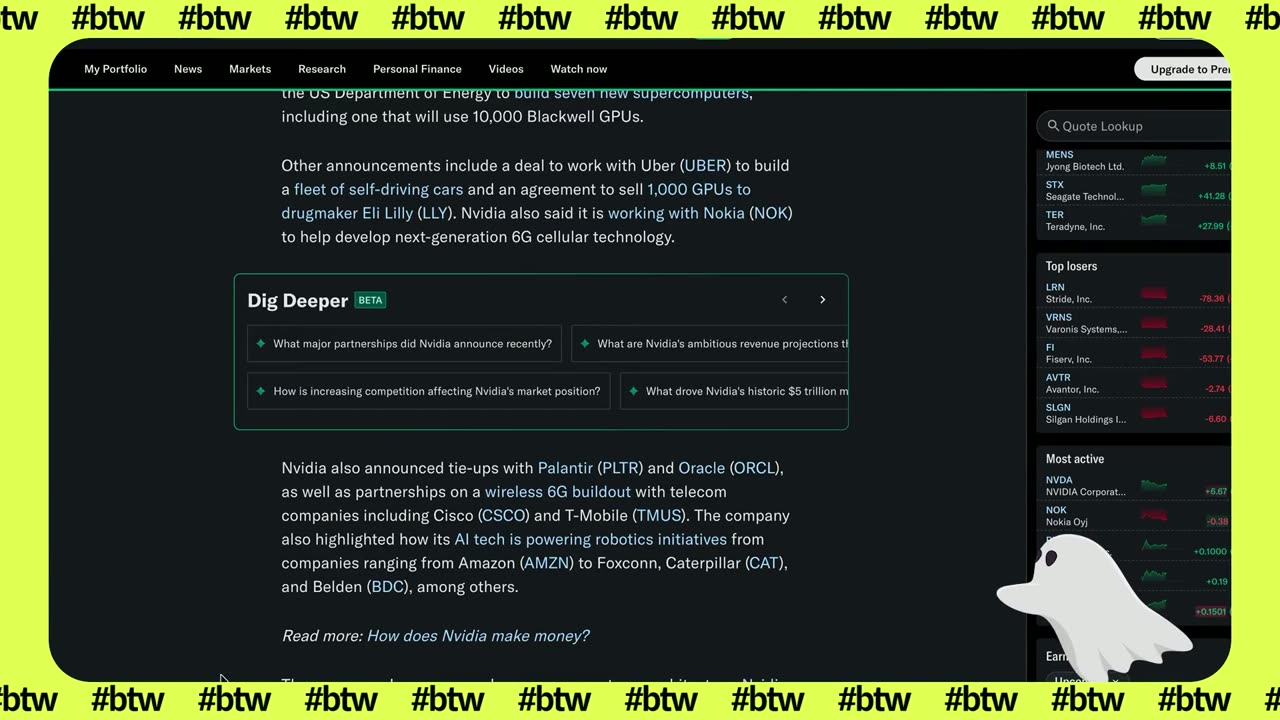
In the news, Sam noted that Nvidia, which he believes was the first company to pass $4 trillion in valuation, crossed $5 trillion that morning, the day after a big presentation where it announced a deal with Nokia. To Sam it is shocking but makes sense, because the need for Nvidia chips is insatiable.
Jordan pointed to the stock still climbing intraday and used a familiar metaphor:
Nvidia is, they're the number one shovel dealer, and they make the best shovels, and everybody's buying their shovels.
— Jordan Metzner, Episode 19
He expects Nvidia to keep breaking records, launch new chips and keep powering the AI revolution. Sam called himself a big believer. His view is that if AI is not a bubble and Nvidia stays the main source of the most efficient chips, it keeps growing, and he was clear this is not financial or stock advice.
Watch the vampire costume reveal, the Beverly Hills and Nashville route runs and the magic mirror on camera in Episode 19 of Built This Week, where the full transcript is also on the page.